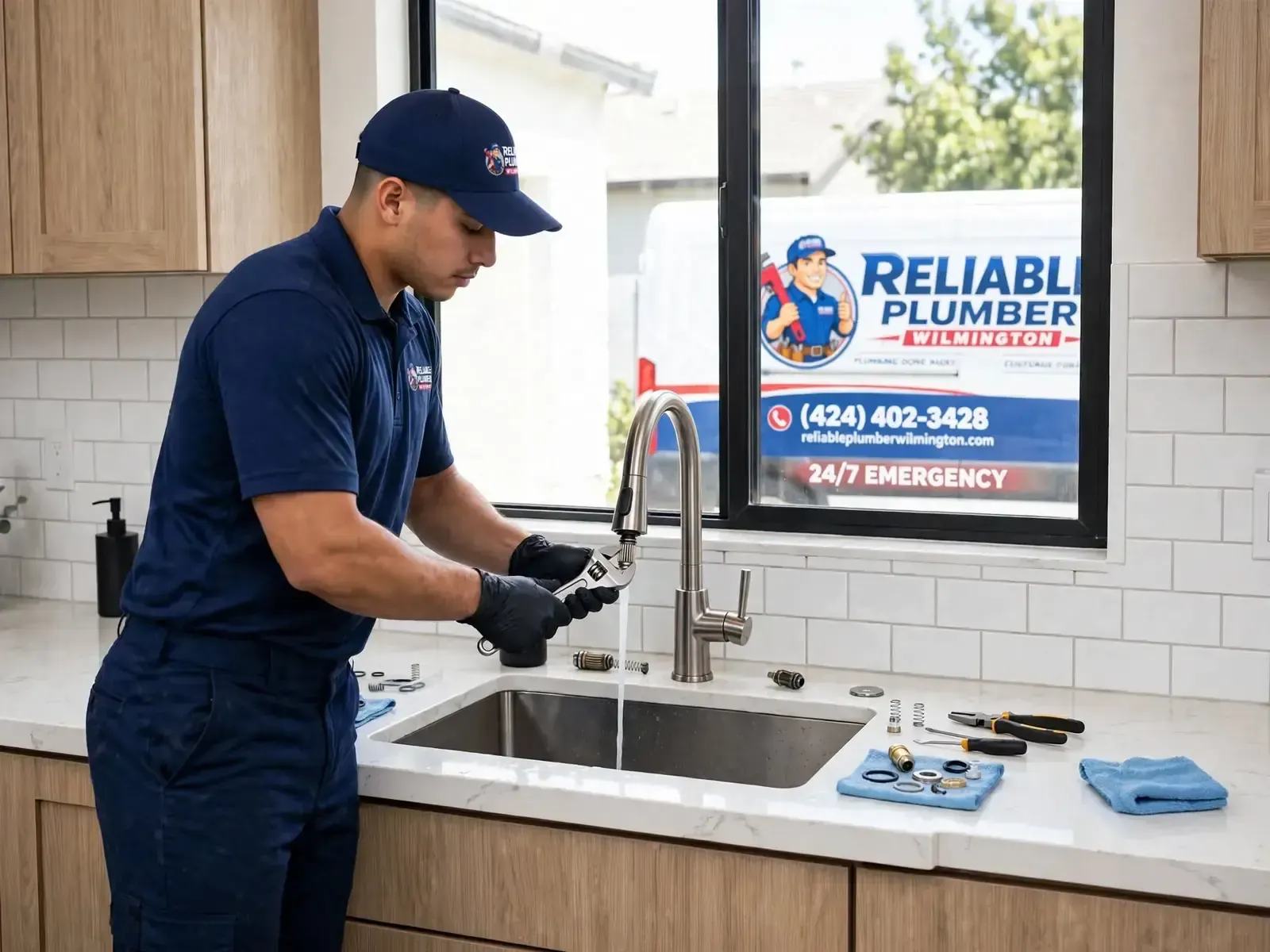
Faucet Repair in Wilmington, CA - The Complete Guide
Taps are the fixture people interact with most and understand least. Almost every fault is one part, and almost every fault here is accelerated by the same cause.
How Hard Water Kills a Cartridge
A cartridge faucet seals by pressing two smooth surfaces together. Water at 7 to 16 grains per gallon deposits calcium and magnesium on those surfaces continuously.
Every time the handle moves, that deposit is dragged across the sealing face. It acts as an abrasive, roughening surfaces that only work when smooth. The cartridge stiffens first - friction from the deposit - and then stops sealing, which is the drip.
This is why the same tap needs attention sooner here than the manufacturer's expected life suggests. Nothing is wrong with the tap or the previous repair; the water is simply doing this continuously.
The Aerator Nobody Checks
The aerator is the small screened fitting at the tip of the spout. It mixes air into the stream and catches debris, and on hard water it accumulates a white mineral crust that progressively restricts flow.
Low flow at one tap while the rest of the house is fine is almost always this. It is frequently mistaken for a pressure problem - and pressure problems are a genuine thing here, but they affect the whole house rather than a single outlet. That distinction is covered on water pressure repair.
Cleaning it requires no tools beyond a cloth to protect the finish. Unscrew, soak in vinegar until the deposit dissolves, rinse, refit. It is the single most cost-effective plumbing maintenance available in this water.
Repair or Replace the Fixture
Repair while the body is sound and parts still exist. Cartridges, seats and O-rings are inexpensive and the labour is a single visit.
Replace when the body is cracked or corroded through, when the finish has failed and is flaking, or when parts are no longer manufactured. Chasing obsolete cartridges for a discontinued model costs more in labour than a new faucet.
There is a third consideration in remodels specifically. New lavatory faucets in California are limited to 1.2 gallons per minute at 60 psi, and SB 407 brings fixture compliance into scope when a pre-1994 property is altered or improved. See faucet installation.
When the Leak Is Not the Faucet
Water under a sink is frequently blamed on the tap and frequently is not. The realistic candidates are the flexible supply connectors, the angle stops that isolate them, the tailpiece connection to the trap, or the trap joints themselves.
These are all easier to reach and cheaper to fix than anything inside the faucet body, and they fail on their own schedule. Flexible connectors in particular have a finite life and fail without warning - replacing ageing ones while a plumber is already under the sink is inexpensive insurance.
Where the water is coming from is what determines the job. That distinction is set out on water leak repair.
References