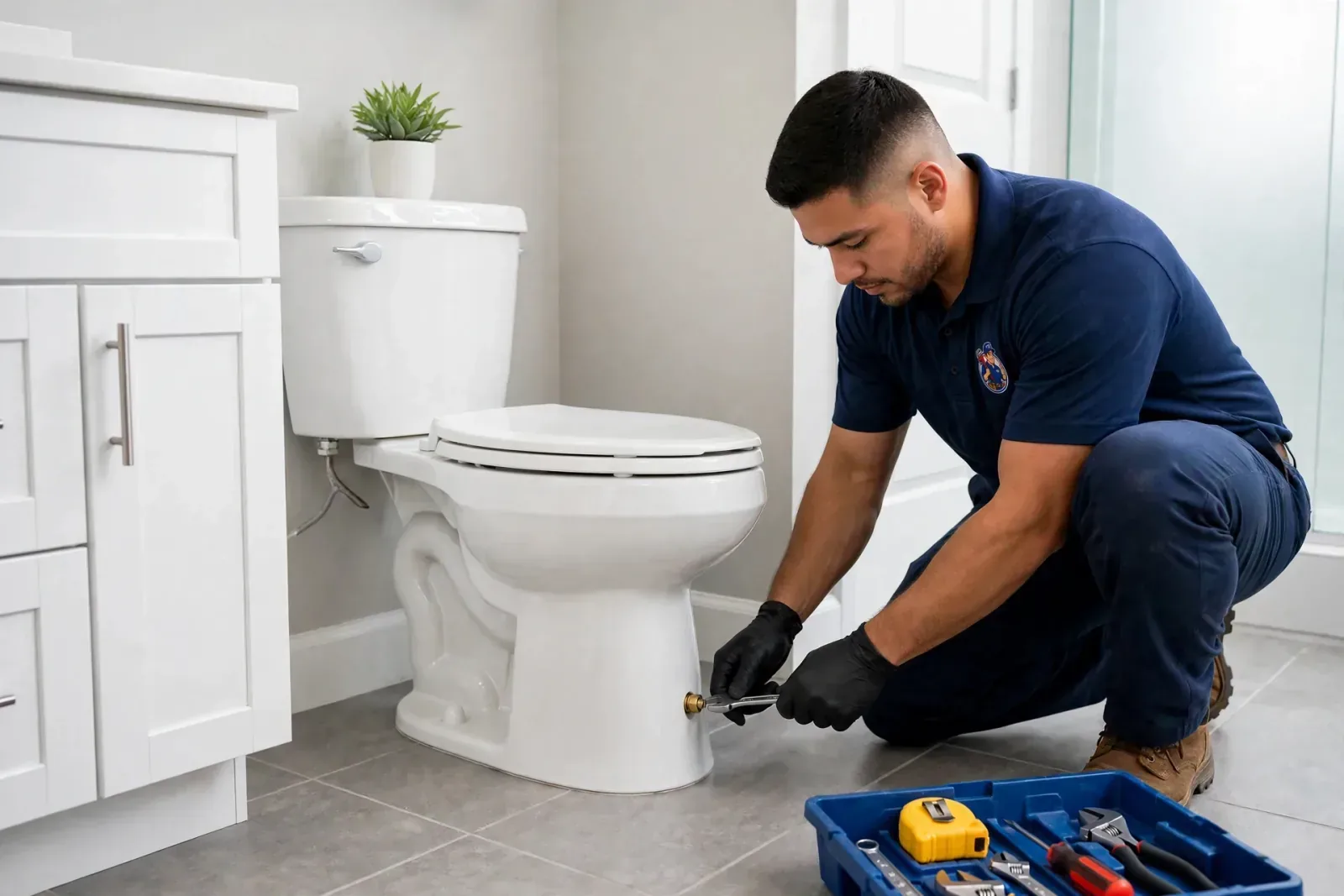
Toilet Installation in Wilmington, CA - The Complete Guide
Fitting a toilet is straightforward work with two things that go wrong: buying the wrong size, and discovering the flange is not sound once the old one is up.
Rough-In, Height and Shape
Rough-in is measured from the finished wall behind the toilet to the centre of the closet flange bolts. Twelve inches is standard and most fixtures are built for it; ten and fourteen inch rough-ins turn up in older properties and need a toilet made to match.
Bowl height is the next decision. Standard height sits lower; comfort height - sometimes called chair height - sits at roughly the height of a dining chair and is easier for most adults and considerably easier for anyone with mobility issues.
Bowl shape is elongated or round front. Elongated is more comfortable and now more common; round front saves a few inches of projection, which matters in a small bathroom where the door or a facing fixture is tight.
The Flange Is What Determines the Job
The closet flange is the fitting that anchors the toilet to the floor and connects it to the drain. Everything about a clean installation depends on it being sound and at the right level.
Two problems appear regularly once the old toilet is lifted. A cracked flange, which will not hold the closet bolts securely and needs repairing or replacing. And a flange sitting below finished floor level - common where flooring has been added over the years - which prevents the wax ring compressing properly and causes repeat seal failures.
Neither is visible before the old fixture comes up, which is why an honest quote treats flange condition as something to be assessed rather than assumed. Getting it right is what prevents the new toilet leaking at the base in two years.
Why 1.28 gpf Is Not a Compromise
People who remember early low-flow toilets are often sceptical, and that scepticism was earned - first-generation low-flush fixtures frequently needed two flushes, which defeated the point.
Modern 1.28 gallon fixtures are engineered differently: redesigned trap-ways, better bowl geometry and improved rim jet distribution. Performance is not the compromise it was, and since every toilet sold in California since 2014 meets the standard, the market has had over a decade to solve it.
The saving is substantial in this housing stock. A pre-1994 fixture at 3.5 gallons or more against 1.28 is roughly a two-thirds reduction on every flush, in a city where water is metered and not cheap.
If You Are Remodelling
This is where SB 407 stops being background information. An alteration or improvement to a pre-1994 property triggers the obligation to replace non-compliant fixtures - not just the one you are touching.
Practically, that means a bathroom remodel in a 1950s Wilmington home should budget for compliant fixtures throughout rather than treating it as an optional upgrade. Discovering it partway through is worse than planning for it.
The related flow limits are worth knowing at the same time, since they apply to everything else going into the room: lavatory faucets at 1.2 gallons per minute at 60 psi, showerheads at 1.8 gallons per minute at 80 psi, and shower valves required to be pressure-balancing or thermostatic with a 120°F cap. See shower installation and faucet installation.
References