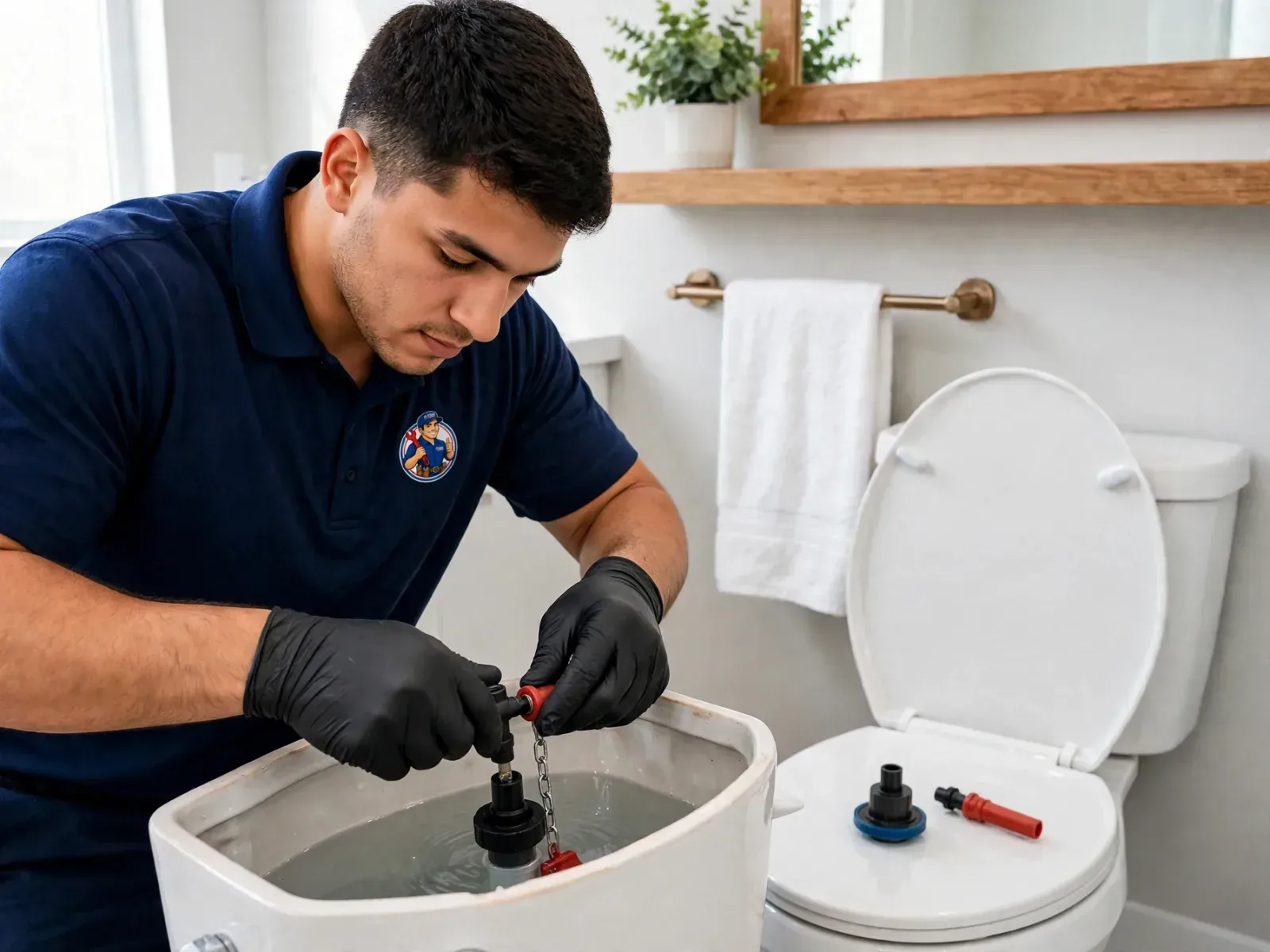
Toilet Repair in Wilmington, CA - The Complete Guide
A toilet is a simple device with four moving parts. Almost every fault traces to one of them, and almost none of them justify replacing the fixture.
How the Flush Actually Works
Pressing the handle lifts the flapper off the flush valve seat. Tank water falls into the bowl fast enough to create a siphon in the trap-way, which pulls the bowl contents into the drain. When the tank empties, the flapper drops and reseals, and the fill valve refills the tank until the float tells it to stop.
That sequence explains the symptoms directly. A flapper that does not seal means water keeps passing into the bowl - continuous running. A flapper closing too early means insufficient water to establish the siphon - a weak flush. A fill valve that does not shut off cleanly means the tank overfills into the overflow tube.
Nothing in that chain involves the porcelain, which is why "the toilet is broken" almost always means "a part inside the toilet needs replacing".
The Hard-Water Complication
Los Angeles water runs 7 to 16 grains per gallon depending on source blend, and the harbor area sits toward the harder end. Scale forms wherever water sits or passes repeatedly.
In a toilet that means three places. The flush valve seat, where mineral deposit prevents the flapper closing cleanly. The fill valve, where scale stiffens the diaphragm and produces hissing or failure to shut off. And the rim jets inside the bowl, where buildup restricts the water that swirls the bowl - a common and rarely diagnosed cause of a weak-seeming flush.
The practical consequence is that fixture repairs here have a shorter interval than manufacturer guidance assumes, and that cleaning the sealing surfaces matters as much as replacing the parts.
Leaks at the Base
Water appearing around the foot of a toilet is usually the wax ring - the seal compressed between the toilet outlet and the closet flange in the floor. It fails through age, or because the toilet has rocked and broken the seal.
Repair means lifting the toilet, removing the old ring, checking the flange for damage, fitting a new seal and resetting the fixture. It is more involved than a tank part but it is still a repair, and the same toilet goes back down.
Two things are worth checking while it is up. Whether the flange itself is cracked or sitting below finished floor level, which is a common cause of repeat wax ring failure. And whether the toilet rocks - an unshimmed toilet will break the next seal too.
When to Stop Repairing
Cracked porcelain in the tank or bowl ends the conversation - that is not repairable and it is a flood risk.
Obsolete parts are the second case. Where a fixture is old enough that flush valves and fill mechanisms are no longer manufactured for it, labour spent sourcing parts exceeds the cost of the fixture.
The third is specific to California and to housing of this age. A toilet predating 1994 typically uses 3.5 gallons per flush or more, against a 1.28 gallon limit on everything sold since 2014. Replacing it cuts water use by roughly two thirds, which usually outweighs any repair - and if the property is being altered or improved, SB 407 brings the obligation into play. That is covered on toilet installation.
References