Drain Cleaning in Wilmington, CA - The Complete Guide
Drains are the most common plumbing call in the country and the most commonly half-fixed. The work is simple. What decides whether you call again in four months is whether anyone established why the line blocked.
Branch Line or Main Line?
Household drainage is a tree. Fixtures feed branch lines, branch lines feed the main sewer lateral, and the lateral feeds the city sewer. A restriction blocks everything upstream of it and nothing downstream, so counting affected fixtures locates the problem before any tool comes out of the van.
One slow sink is a branch problem, and this page covers it. Two or more fixtures slowing together, a toilet gurgling when the washing machine drains, or a floor drain backing up first all place the restriction in the main lateral - that is sewer line cleaning, and cabling one fixture will not touch it.
What Blocks Each Kind of Line
Kitchen lines block with grease. It enters warm and liquid, cools on the pipe wall, and then catches food particles against the sides until the bore closes. This is why kitchen blockages recur so reliably - the cause is a coating, not an object.
Bathroom lines block with hair bound into soap scum. Harbor-area water sits at the harder end of the 7 to 16 grains per gallon Los Angeles range, and harder water produces more scum, so these lines foul faster here than in soft-water areas.
Laundry lines block with lint and detergent residue. Floor drains block with sediment. Toilets block with items that were never going to pass, and with mineral buildup narrowing the trap-way over years.
Snake, Auger or Jet
A drain snake is a hand-operated flexible coil that navigates traps and bends to hook a clog and pull it out. It suits hair and soft blockages in small lines close to the fixture.
A powered auger is the heavier tool: it breaks the clog apart and travels considerably further down the line. Plumbers distinguish the two even though most homeowners use the words interchangeably - the snake retrieves, the auger breaks through.
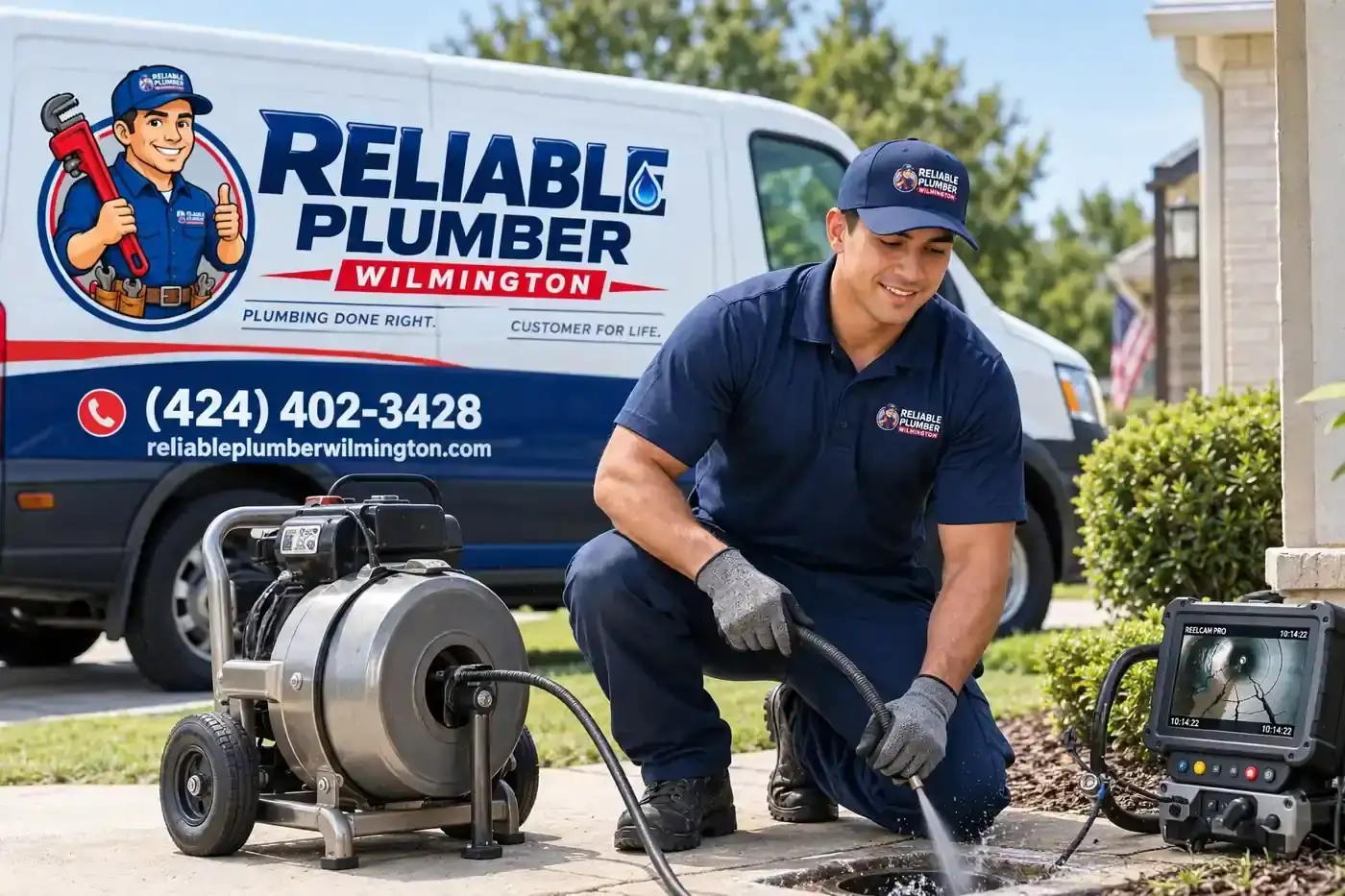
Neither cleans the pipe wall. Hydro jetting does, by scouring the bore back to full diameter with high-pressure water. On sound residential lines that runs at 2,500 to 3,000 PSI; on older cast iron and clay it is dialled back to 1,500 to 2,000 PSI, because pressure suited to good pipe can crack pipe that is already compromised.
Why Wilmington Drains Recur More
Housing in 90744 is largely 1940 to 1969. The drain and waste lines in those homes are cast iron, which has a service life of 50 to 100 years but scales internally long before it fails.
That scale narrows the bore permanently. A line that started at four inches and now runs at three catches material that would have passed a new pipe without incident. The blockage looks like the problem; the reduced diameter is the problem.
This is why a second blockage in the same line is worth a camera rather than another cable. It distinguishes a line with twenty good years left from one heading toward repair, and that distinction is the difference between budgeting and being surprised.
What It Costs
A simple fixture clog runs $100 to $300 in Los Angeles. Snaking runs $140 to $360, roughly an hour of labour depending on line size. A camera inspection adds $100 to $300 when run alongside other work, and hydro jetting runs $350 to $600.
Those are market ranges rather than our quote, published because no competitor in the harbor area publishes any figure at all. Your number depends on access and how far down the line the blockage sits, and you should have it before anyone starts.
References