Sewer Camera Inspection Wilmington CA

A camera travels the lateral and shows the actual condition - scale, cracks, offsets, root intrusion or a belly. It converts a guess about a buried pipe into a decision you can make with evidence.

Reliable Plumber Wilmington review platform
Sewer Camera Inspection in Wilmington, CA

The Only Honest Way to Judge a Buried Pipe

Everything else is inference. A recurring blockage suggests a problem, a slow drain suggests a restriction, and an experienced plumber can narrow the possibilities considerably - but nobody can tell you whether a lateral has twenty good years left or two without looking inside it.

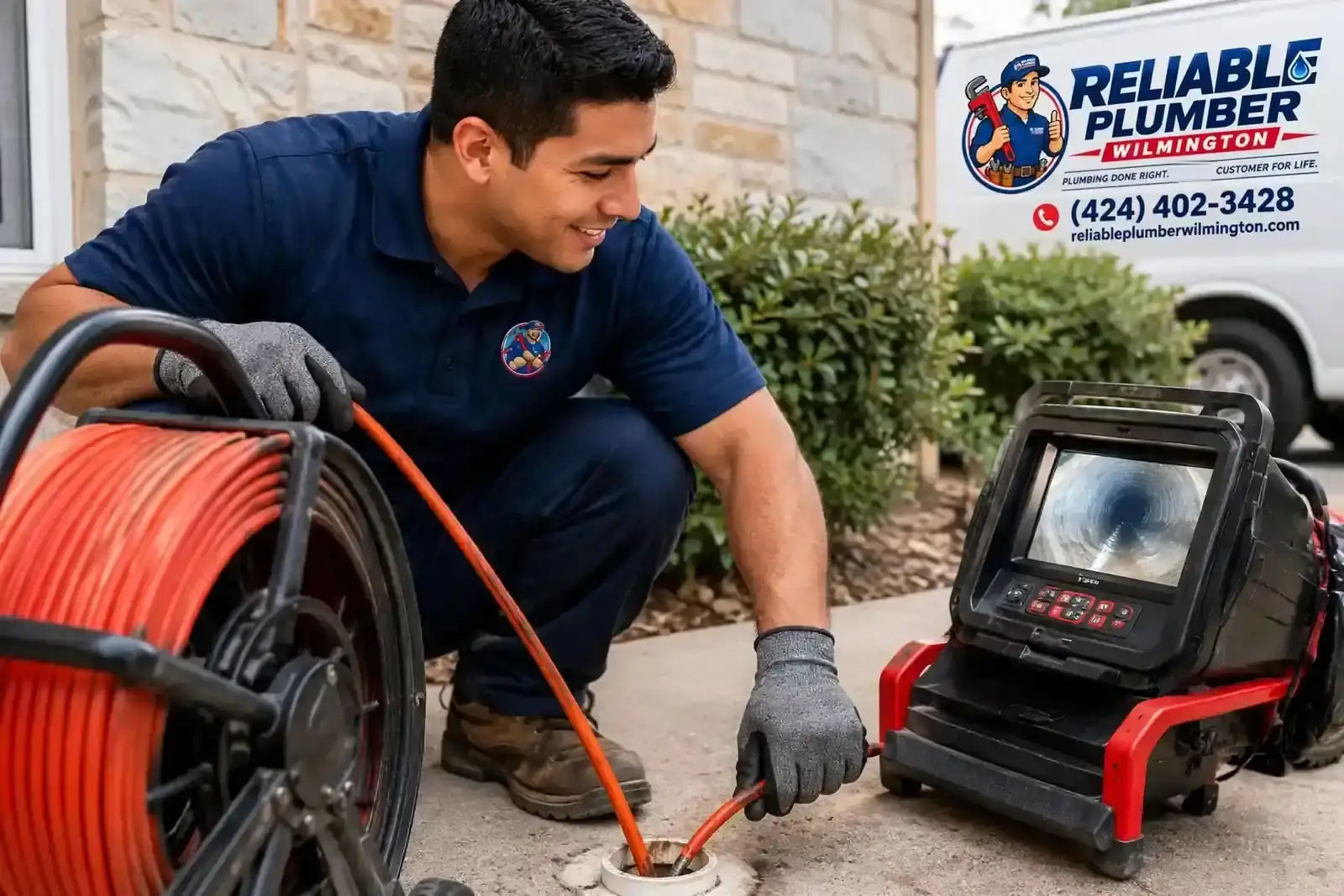
A camera on a flexible rod is fed in through a cleanout or fixture opening and travels the line, transmitting live footage as it goes. It navigates bends, and it shows the interior surface continuously rather than at sample points.

That matters most in exactly two situations: before you commit money to a repair, and before you buy a house. In both, the cost of looking is trivial against the cost of being wrong.

Wilmington 90744 note: housing here dates mostly to 1940-1969, which is the era of cast iron and clay laterals - and, in some homes of that period, Orangeburg, a compressed-fibre pipe that deteriorates and eventually collapses. Those three materials fail in visibly different ways, and a camera distinguishes them in minutes. Age alone cannot.

What the Camera Actually Finds

Six findings, in roughly the order of how often they turn up in this housing stock.

Root intrusion

The most common finding in Los Angeles laterals. Roots enter through joints that have already cracked or pulled apart, then expand and trap debris passing through.

Scale and buildup

Cast iron scaling internally, narrowing the bore. This is what makes blockages recur, and it is treatable with jetting rather than replacement.

Cracks and broken sections

Ground settling and simple age crack lines and break sections. The camera shows both the damage and exactly how far along the run it sits.

Offset joints

Joints pushed out of alignment by ground movement. They catch material continuously and are a common entry point for roots.

A belly

A section sagging into a low spot where water and solids collect permanently. Important to identify, because lining cannot correct it - only replacement restores the slope.

Orangeburg pipe

A compressed-fibre material used in some mid-century homes. It deteriorates and collapses with age, and finding it changes the plan immediately.

Your Home Inspection Did Not Cover the Sewer

This surprises buyers routinely, and it is the single most expensive gap in a standard inspection.

Explicitly Excluded
Buried systems fall outside standard inspection scope
Not Equipped
A general inspector has no camera for the lateral
You Inherit It
The lateral becomes your responsibility at closing
The Exposure
Sewer repairs commonly run into five figures

Under the standard practices governing home inspections, underground buried systems are explicitly excluded from scope. A general inspector is neither required nor equipped to evaluate the interior condition of the main sewer line.

That means the most expensive single component you are buying is the one nobody looked at. A sewer scope before closing reveals defects a standard inspection cannot, and it does so while you still have the option to renegotiate or walk away.

In Wilmington the exposure is higher than average for one specific reason: the housing stock is old enough that laterals are cast iron, clay or occasionally Orangeburg, and old enough that many of them are inside or past their service window. In the City of Los Angeles the buyer also inherits responsibility for the entire lateral, including the section running under the street.

The cost asymmetry is stark. A camera inspection is a few hundred dollars. A lateral replacement is not.

Need Sewer Camera Inspection in Wilmington?

Cause diagnosed before anything is quoted · price agreed before work starts · 24/7 dispatch

Sewer Camera Inspection Price Ranges in Los Angeles County

Published ranges. The spread is wide because a standalone inspection with locating is a different job from a camera run alongside other work.

WorkRangeWhat moves it
Camera inspection add-on$100 - $300Run alongside drain or jetting work
Standalone sewer inspection$275 - $1,800National range; Los Angeles quotes run toward the higher end
Pre-purchase sewer scopequoted per propertyAccess, line length and whether locating is needed

Set any of those against a lateral replacement, and the inspection is the cheapest decision in the whole sequence.

Sewer Camera Inspection in Wilmington, CA - The Complete Guide

Cameras turned sewer work from guesswork into diagnosis. On housing of this age that shift matters more than almost any other tool a plumber carries.

How the Inspection Runs

A camera head on a flexible push-rod enters through a cleanout where one exists, or through a fixture opening where one does not. It travels the line while transmitting live footage, passing bends and junctions as it goes.

A good inspection is not just a video. It identifies what is wrong, locates it - how far along the run, and often where that sits above ground - and distinguishes findings that need action from findings that simply describe an old pipe. Locating is what makes any subsequent repair targeted rather than exploratory.

You should expect to watch the monitor, and you should expect to be given the footage. A recommendation you cannot see the evidence for is an assertion.

Why a Belly Matters More Than It Sounds

A belly is a section of pipe that has sagged into a low spot, usually through ground settling. Water and solids collect there permanently instead of flowing through, which produces recurring blockages that no amount of clearing resolves.

It matters disproportionately for one reason: it changes which repairs are possible. CIPP lining cannot correct a belly, because the resin liner conforms to the shape of the existing pipe. Where the slope itself needs restoring, replacement is the only option that works.

Finding a belly before choosing a repair method is therefore not a detail. It rules an entire approach in or out.

What Findings Lead Where

Scale and grease buildup, with the pipe structurally sound: hydro jetting. The camera also sets the safe pressure, which on older cast iron means 1,500 to 2,000 PSI rather than 2,500 to 3,000.

Localised damage in an otherwise good line: a spot repair. See sewer line repair.

Widespread cracking, multiple offsets, root intrusion at several joints, or a collapse: full-length replacement, which is where trenchless methods earn their cost by avoiding an open trench across the property.

A belly: replacement, because slope cannot be lined back into a pipe.

Keep the Footage

The recording is a baseline. If the line blocks again in two years, comparing new footage against old tells you whether deposit has rebuilt or a defect has developed - two situations that look identical from inside the house and call for completely different responses.

It is also the document that settles disagreements. In a neighbourhood where roughly nine in ten homes are rented, an image of scale inside a sixty-year-old cast iron lateral establishes what caused a backup far more efficiently than any conversation about tenant use.

References
Sewer Camera Inspection Questions

Answers specific to sewer camera inspection in Wilmington 90744.

Root intrusion, scale and buildup, cracks, broken sections, offset joints, bellies where the pipe has sagged, and the pipe material itself. It also locates each finding along the run so any repair is targeted.

Yes, particularly here. Standard home inspections explicitly exclude buried systems, so the sewer lateral is the most expensive component nobody looked at - and in Los Angeles you inherit responsibility for all of it, including the part under the street.

No. Under standard inspection practices, underground buried systems are outside scope, and a general inspector is neither required nor equipped to assess the interior of the main sewer line.

A section that has sagged into a low spot where water and solids collect. It matters because lining cannot fix it - the liner conforms to the existing shape, so restoring slope requires replacement.

Typically $100 to $300 as an add-on alongside other drain work. A standalone inspection runs $275 to $1,800 nationally, with Los Angeles quotes toward the higher end depending on access and locating.

Yes, and you should insist on it anywhere. You should be able to watch the monitor during the inspection and keep the recording afterwards as a baseline for comparison later.

Book Sewer Camera Inspection in Wilmington

Licensed, bonded and insured · diagnosis before price · 30 cities across Los Angeles County