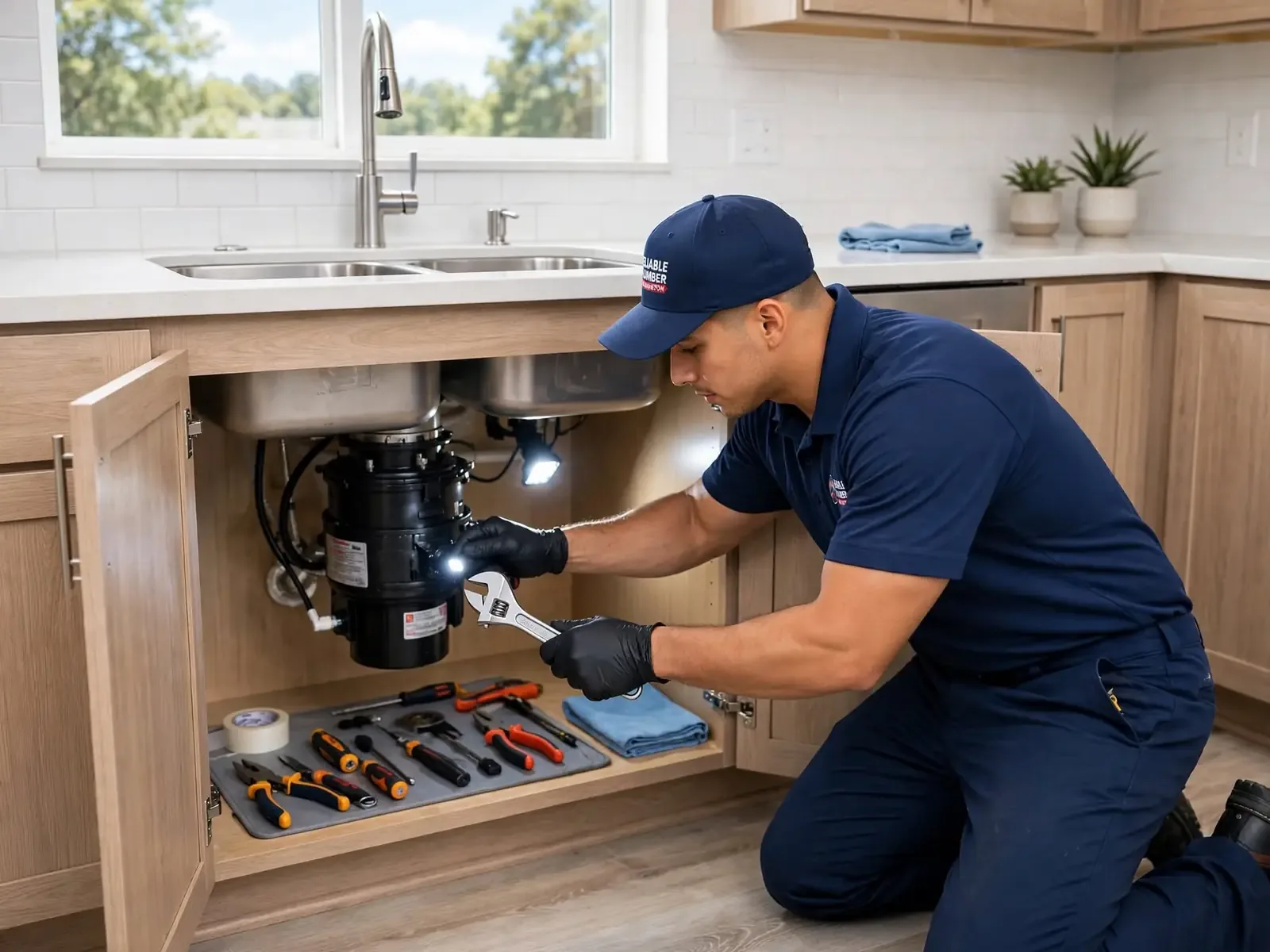
Garbage Disposal Repair in Wilmington, CA - The Complete Guide
Disposals are simple machines with a small number of failure modes, and two of the most common ones the owner can resolve without a plumber.
The Reset Button
Every disposal has a thermal overload protection device with a reset button, almost always on the underside of the unit and usually red. When the motor draws too much current - typically from a jam, or from grinding a heavy load - the overload trips and cuts power to protect the motor.
A disposal that is completely dead has very often simply tripped. Pressing the reset restores it, and if the underlying jam has cleared itself the unit works normally again.
This is worth knowing because it is the single most common "fault" that turns out not to be one. Check the reset before the breaker, and the breaker before calling anyone.
Understanding the Hum
A hum means the motor is energised and the plate is not turning. Something is physically preventing rotation - usually a foreign object wedged between an impeller and the grind ring.
The critical thing is to stop switching it on. A stalled motor draws heavily and heats fast, and repeated attempts are what convert a clearable jam into a burnt-out motor. That turns a short visit into a replacement.
Clearing is straightforward with power isolated: the plate is freed using the hex fitting on the underside of most units, and the obstruction retrieved from above with tongs. Never by hand, and never with the unit merely switched off at the wall rather than isolated at the breaker.
Where the Leak Is
Leaks fall into three categories with very different implications. At the top, the mounting flange where the unit meets the sink - a seal failure, repairable by dropping the unit, resealing and remounting.
At the side, where the dishwasher hose or the discharge tube connects - usually a gasket or a loose connection, and among the simplest repairs there is.
From the body of the unit itself - corrosion through the housing. That is not repairable, and since a replacement runs $320 to $776 installed, rebuilding is not economic.
Identifying which of the three before a quote is worth insisting on, because from inside a cupboard they can look identical.
When It Is Not the Disposal
A unit that grinds normally but leaves the sink draining slowly is not faulty. The waste is being ground; the line below is not carrying it away.
In this housing stock that usually means grease buildup in an ageing kitchen branch line. Cast iron drain lines from the 1940s to 1960s scale internally, which narrows the bore and gives grease somewhere to catch - and a disposal, by definition, sends a continuous supply of food waste into that.
Replacing the disposal in that situation solves nothing. Drain cleaning is the right service, and if the blockage keeps returning, hydro jetting removes the coating rather than boring through it.
References