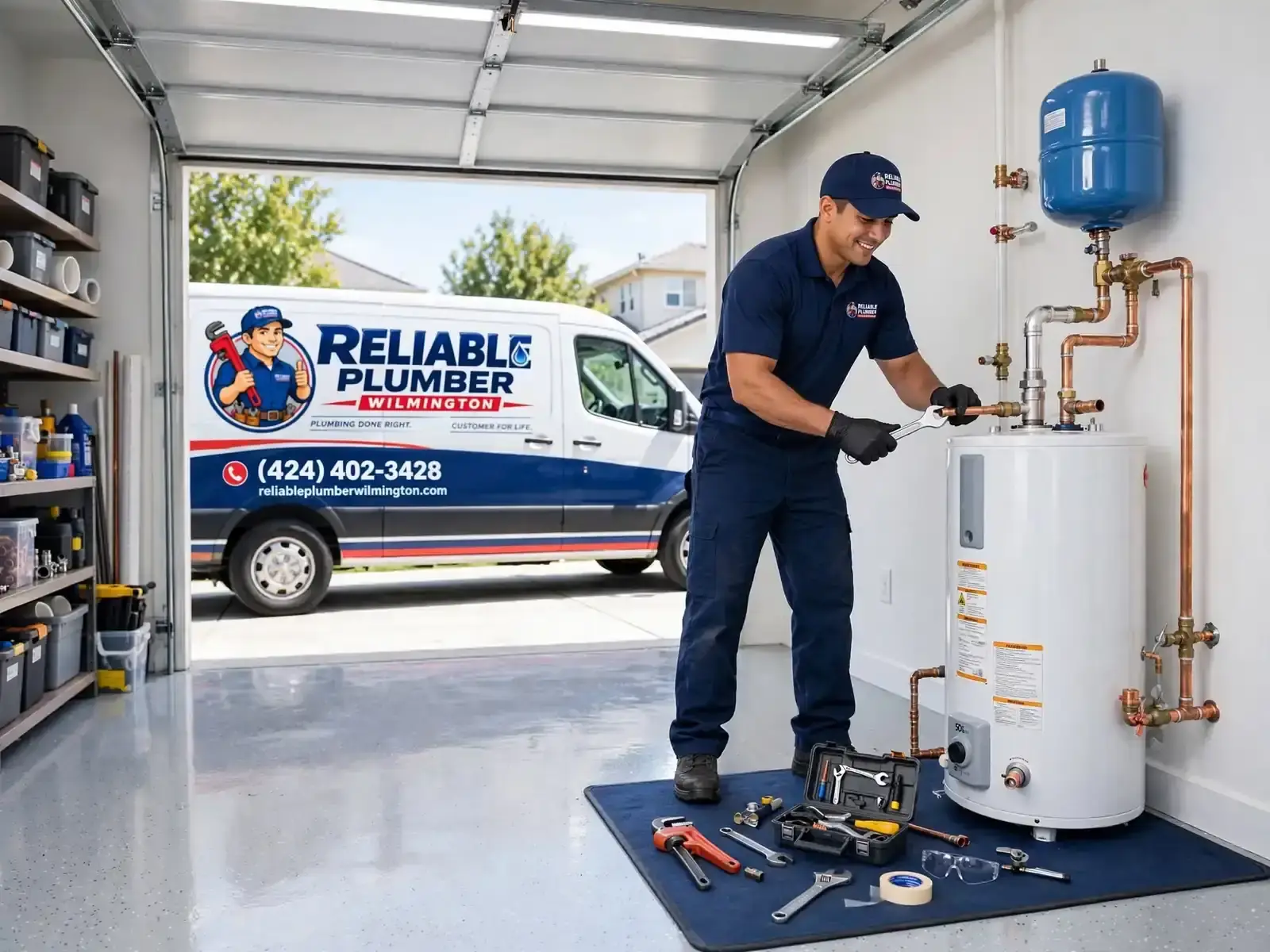
Water Heater Installation in Wilmington, CA - The Complete Guide
The difference between a cheap water heater quote and an expensive one is usually not the appliance. It is whether the quote includes the four things an inspector will look for.
Sizing Properly
Tank capacity in gallons is the number everyone quotes, and on its own it is misleading. What determines whether you run out of hot water is the first-hour rating: how many gallons the unit can actually deliver in an hour, which combines stored capacity with how fast it reheats.
Two 40-gallon tanks with different recovery rates behave very differently for a family taking consecutive showers. A high-recovery unit can outperform a physically larger one with a slow burner.
A workable starting point is roughly 20 gallons as a baseline plus about 10 gallons per resident, and around 12 gallons of hot water per person per day for ordinary use. Then check the FHR against the household's actual peak - usually a weekday morning.
Resist upsizing without a reason. A larger tank holds more water at temperature continuously, so it loses more heat standing idle, and on hard water there is simply more surface for scale to form on.
Why Strapping Is the Item That Fails
It is the most commonly failed inspection item on water heater work in the city, and the reasons are mundane. Straps fitted to drywall rather than framing. Only one strap where two are required. The lower strap positioned over the gas control instead of at least four inches above it.
None of those are difficult to get right, and all of them are cheap on the day. Retrofitting compliant strapping later means returning to a unit that is already installed and plumbed, in a space that is usually tight. It is the definition of a false economy.
It also matters for the reason the law exists. An unstrapped tank is what tears the gas line loose during ground movement, and that turns an earthquake into a fire.
Expansion Tanks and Closed Systems
Many Los Angeles properties have a pressure-reducing valve, because California Plumbing Code requires one wherever static pressure exceeds 80 psi. A PRV or a backflow preventer makes the plumbing a closed system.
In a closed system, water heated in the tank expands and cannot push back into the main. Pressure rises until something relieves it, and the thing that relieves it is the T&P valve - which then drips, and eventually fails from repeated operation.
A thermal expansion tank absorbs that expansion. It is a small component, it is required where a PRV or backflow preventer is present, and its absence is the second most common inspection rejection. If you have had a T&P valve dripping repeatedly, this is frequently why.
The Permit and Inspection Sequence
LADBS requires a permit for nearly every water heater replacement in the City of Los Angeles. Roughly 80% qualify for an Express Plumbing Permit issued online through PermitLA, often within the hour, at $125 for a standard tank or $175 for a tankless conversion.
Inspection is typically scheduled two to five business days after the installation completes. The inspector verifies the seismic straps, the expansion tank, the T&P relief and the drain pan.
It is worth insisting on this even where nobody would notice. An unpermitted water heater surfaces at resale, when a buyer's inspection flags it and the work has to be opened up and certified retrospectively - at which point it costs several times what the permit would have.
References