Tankless Water Heater Installation in Wilmington, CA - The Complete Guide
Tankless is genuinely better at some things and genuinely more demanding to install. Both halves of that sentence matter when the housing stock is eighty years old.
How a Tankless Unit Works
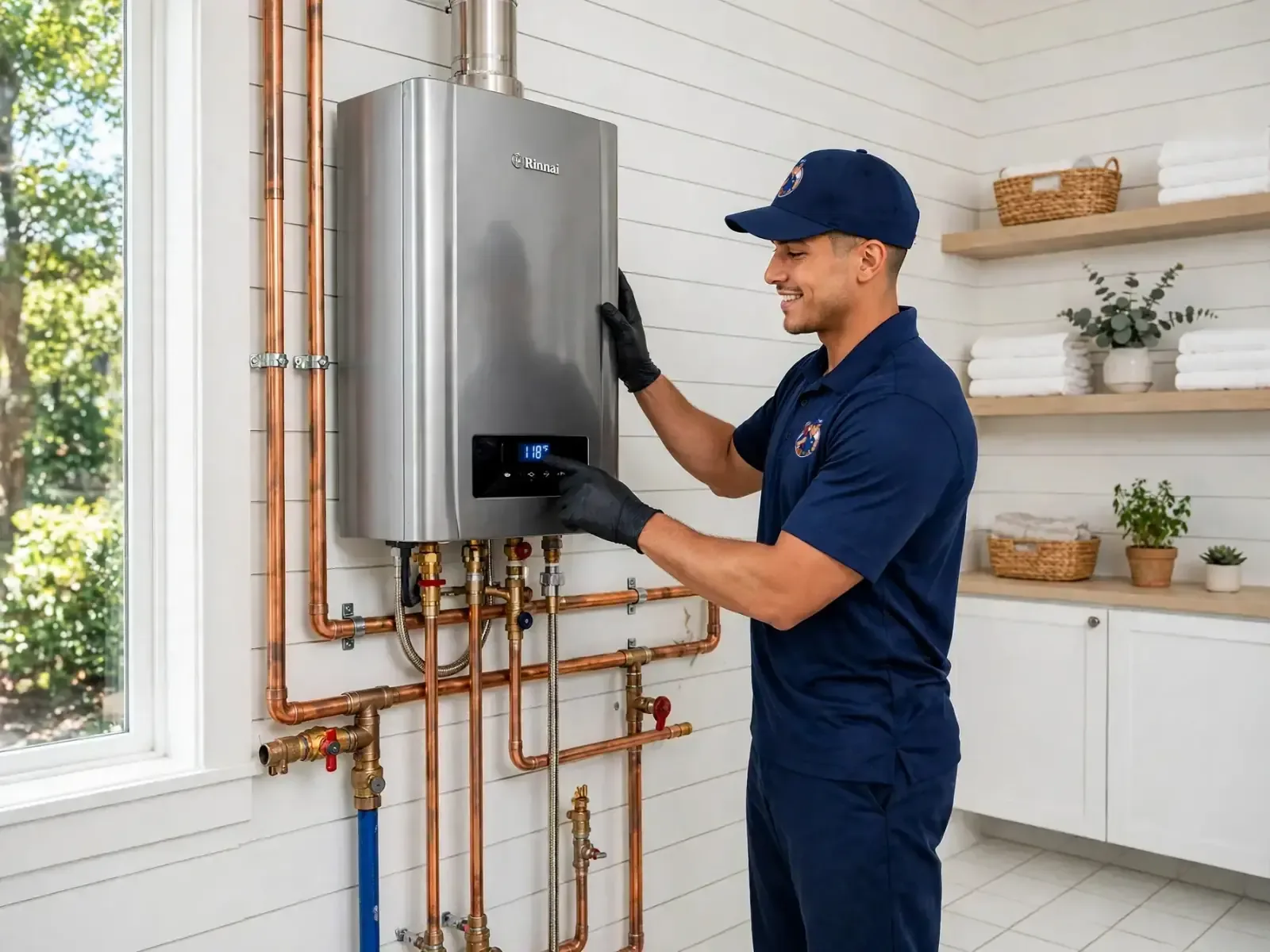
There is no stored water. When a hot tap opens, flow is sensed, a burner or element fires, and water is heated as it passes through a heat exchanger. When the tap closes, heating stops.
Two consequences follow directly. You cannot run out, because there is no reservoir to exhaust - output is limited by flow rate rather than volume. And there is no standby loss, because nothing is being kept hot between uses.
The trade-off is that all the heating has to happen in the seconds water takes to pass through, which is why the peak energy demand is so much higher than a tank's.
The Gas Line Problem
This is the item that most often surprises people, and it is worth understanding rather than just budgeting for.
A 40-gallon tank heater might draw around 40,000 BTU while recovering, intermittently. A whole-house tankless unit can draw 150,000 to 199,000 BTU while running. The existing gas line was sized for the former.
An undersized line does not simply reduce performance - it can starve the appliance and prevent it reaching its rated output, which is exactly the capability you paid for. Establishing whether your line is adequate is part of a competent quote, not an optional survey.
Why Hard Water Changes the Calculation Here
Los Angeles water runs between 7 and 16 grains per gallon depending on the source blend, and the harbor area sits toward the harder end because of its Colorado River share.
In a tank heater, minerals settle out onto the tank floor. That is inefficient and shortens tank life, but the deposit sits somewhere relatively harmless and flushing removes it.
In a tankless unit, water passes directly across the heat exchanger - and that is where scale forms, on the surfaces doing the heating. Left alone it reduces output, raises running temperature and eventually damages the exchanger. Descaling on a schedule is therefore not optional maintenance in this water; it is a condition of the unit lasting.
This is not an argument against tankless. It is an argument for budgeting the ongoing cost honestly and fitting isolation valves at installation so servicing is straightforward.
Who Should and Should Not Convert
Convert if you regularly run out of hot water, if floor space is genuinely valuable, if you are planning to stay long enough to recover the higher upfront cost, and if the gas line and venting work is affordable in your situation.
Stay with a tank if the current unit has always kept up, if the gas line would need a long expensive run, if the property is a rental where descaling is unlikely to happen reliably, or if the budget is tight - because a like-for-like replacement is substantially cheaper and there is nothing wrong with it.
The worst outcome is converting on the appliance price and discovering the gas line and venting afterwards. Get all three quoted together.
References