Water Heaters in Wilmington, CA - The Complete Guide
A water heater is the most predictable appliance failure in a house. It has a known service
life, a known failure mode, and a maintenance task that measurably extends it. Almost nobody
performs that task, which is why most replacements happen as emergencies.
How a Tank Heater Actually Fails
Cold water enters at the bottom of the tank and is heated from below by a gas burner or an
electric element. Minerals in that water - calcium and magnesium - come out of solution as it
heats and settle on the tank floor, which is exactly where the heat is applied.
That sediment layer insulates. The burner has to run longer and hotter to drive heat through
it, so the steel above the burner runs above its design temperature for years. The glass
lining eventually crazes, the steel beneath corrodes, and the tank leaks from the body. At
that point nothing is repairable, because the failed component is the tank.
The sacrificial anode rod is the counterweight to this. It is a magnesium or aluminium rod
that corrodes preferentially so the steel does not. Once it is consumed, corrosion moves to
the tank. Checking a rod is cheap; replacing a tank because nobody checked one is not.
Why Harbor-Area Water Makes This Worse
Los Angeles tap water runs between 7 and 16 grains per gallon depending on the source blend
serving a given neighbourhood, and the harbor area sits toward the harder end because of its
Colorado River share. More dissolved mineral means a faster-building sediment layer, which
means the mechanism above runs faster.
The practical consequence is that manufacturer maintenance advice written for national
averages understates what is needed here. A tank flushed on a schedule matched to local
hardness lands at the long end of the 8-to-12-year range;
one that is never flushed lands at the short
end, or below it.
Repair or Replace - the Actual Arithmetic
Three questions settle it. How old is the unit? Where is the fault? What does the repair cost
against a replacement?
Under eight years with a failed thermostat, element, thermocouple or gas valve, repair is
straightforward - those are inexpensive parts on a unit with years left. Over twelve with the
tank body leaking, the decision is already made. In between, the useful test is the half
rule: if the repair exceeds half the cost of replacement, you are buying time rather than
reliability. See water heater repair for what is
actually fixable.
What a Compliant Installation Includes
In the City of Los Angeles a replacement is a permitted job. LADBS requires a permit for
nearly every water heater replacement, most qualify for an Express Plumbing Permit online,
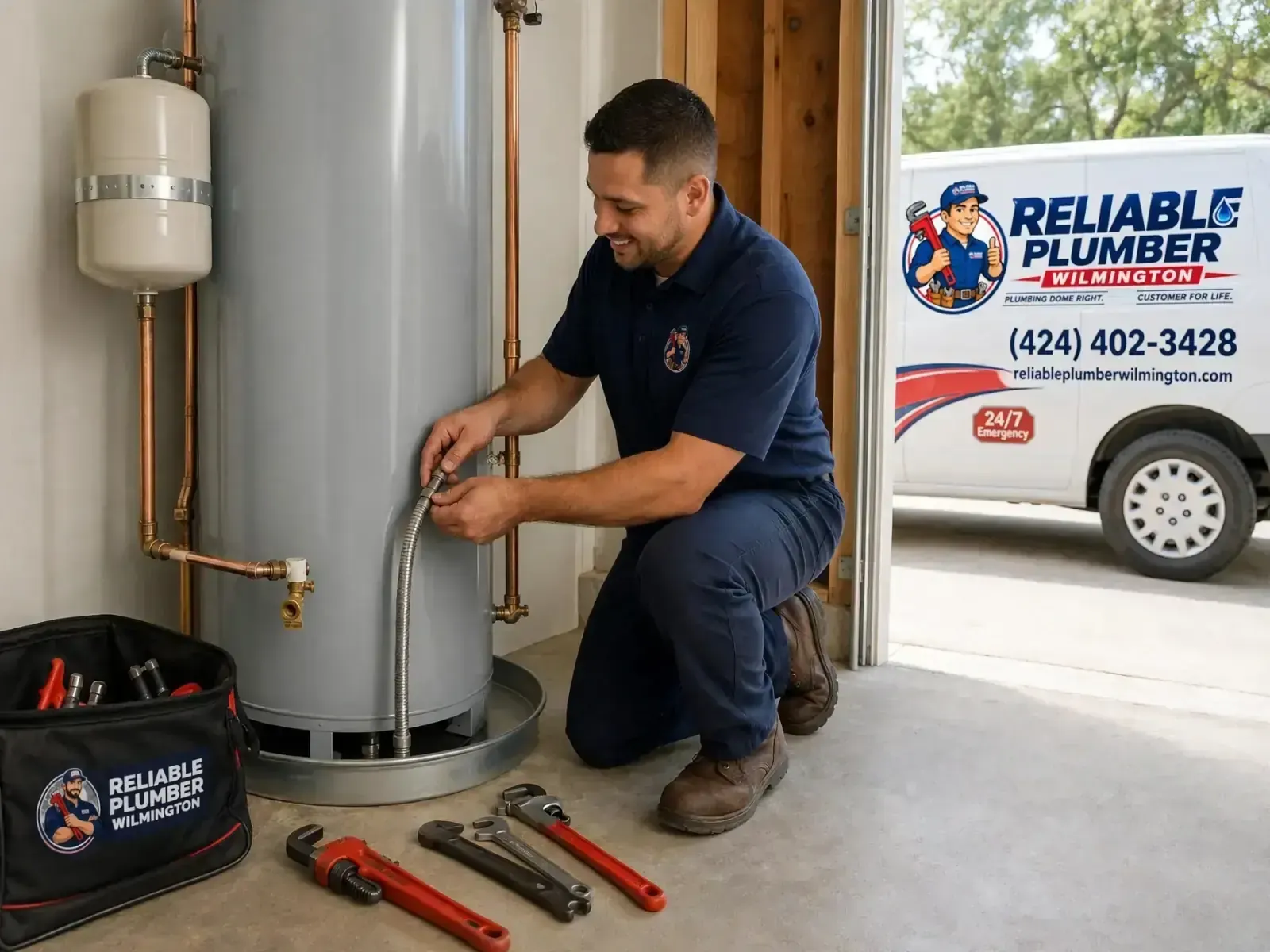
and an inspector verifies four things: two seismic straps anchored into framing, a thermal
expansion tank where a pressure-reducing valve or backflow preventer is present, a working
T&P relief valve, and a drain pan.
Strapping fails inspection more often than anything else, and the expansion tank is second.
Both are inexpensive at install time and both are disproportionately expensive to retrofit
later, which is the argument for getting them right the first time rather than discovering
them at resale. Full detail on
water heater installation.
What It Costs Here
A straightforward repair starts around $125 in Los Angeles, though a failed gas valve or
control board runs well above that. Tank replacement averages about $1,740 installed, with
most falling between $1,140 and $2,410; a fully compliant 50-gallon gas installation is more
commonly quoted at $2,200 to $3,500. Tankless averages around $2,668 with a range of $1,616
to $3,829 before conversion work. Venting modifications add $200 to $600, and the LADBS
permit is $125 for a tank or $175 for a tankless conversion.
Those are market ranges rather than our quote, published because no competitor in the harbor
area publishes any figure at all.
References