Hydro Jetting in Wilmington, CA - The Complete Guide
Hydro jetting is the most oversold and most under-explained service in residential drainage. It is genuinely the right answer to some problems and an unnecessary expense for others, and the difference is easy to state.
How It Works
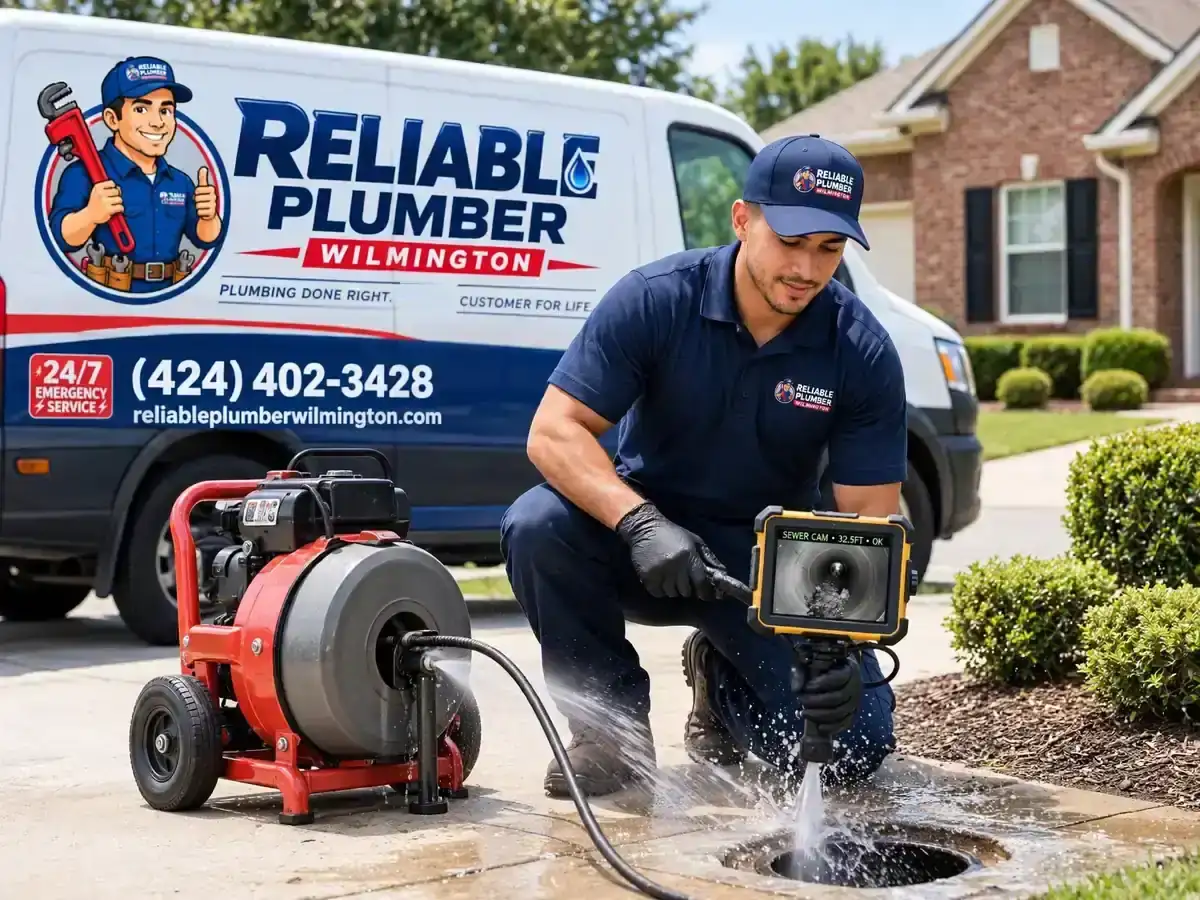
A high-pressure hose with a specialised nozzle is fed into the line. The nozzle directs jets of water backwards against the pipe wall, which both propels the hose forward and scours deposit off the interior surface as it travels.
The result is different in kind from cabling. A cable produces a hole through an obstruction; jetting produces a pipe restored to something close to its original internal diameter. On a line whose problem is a coating rather than a blockage, that distinction is the entire point.
When Jetting Is the Right Call
Recurring blockages in the same line. This is the clearest signal, because recurrence means the cause was never removed.
Kitchen lines with a grease history. Grease coats rather than obstructs, and no mechanical tool takes a coating off a pipe wall.
Ageing cast iron laterals with internal scaling, where the bore has narrowed enough that ordinary material no longer passes cleanly.
Root intrusion, in combination with cutting - though roots entering a line means a joint has already failed, and that leads to sewer line repair rather than ending with the jetting.
When It Is Not
A first-time blockage with no history. Cable it, and spend the difference on nothing at all.
A line whose camera footage shows structural failure. Jetting a collapsed or badly cracked lateral does not repair it, and at the wrong pressure will make it worse. That line needs replacement.
Any situation where nobody has looked inside the pipe. On housing this age that is not caution, it is the minimum standard.
The Pressure Question
Residential sewer laterals in good condition are typically jetted at 2,500 to 3,000 PSI. Older cast iron and clay lines are run at 1,500 to 2,000 PSI. Equipment capable of far higher pressures exists and is used on commercial and municipal work.
Matching pressure to pipe is the whole safety argument. Jetting is safe on cast iron when a camera inspection has established the pipe's condition first; older or damaged pipe can crack under pressure selected without that information.
This is why "we jet drains" is an incomplete answer to a question about an old house. The useful question is what pressure, based on what evidence.
What It Costs
Hydro jetting in Los Angeles typically runs $350 to $700, with difficult sewer blockages, root intrusion, access problems or additional inspection pushing a job past $1,000. A camera inspection alongside adds $100 to $300.
Set against cabling at $140 to $360, jetting is the more expensive visit. It is the cheaper outcome on a line that would otherwise be cabled twice a year, and the more expensive one on a line that blocked once because something went down it that should not have.
References