Shower Repair in Wilmington, CA - The Complete Guide
Behind every shower handle is a valve, and inside most valves is a cartridge. Knowing which of the two has failed is the difference between a modest repair and an opened wall.
What the Cartridge Does
A single-handle shower valve uses a cartridge to control both flow volume and the hot-cold mix. Moving the handle slides or rotates the cartridge within the valve body, changing which ports align and in what proportion.
Nearly every common shower complaint is that cartridge failing to do one of those two jobs. Dripping means it is not shutting flow off completely. Poor temperature control means it is no longer proportioning hot and cold correctly. Stiffness means scale has built inside it.
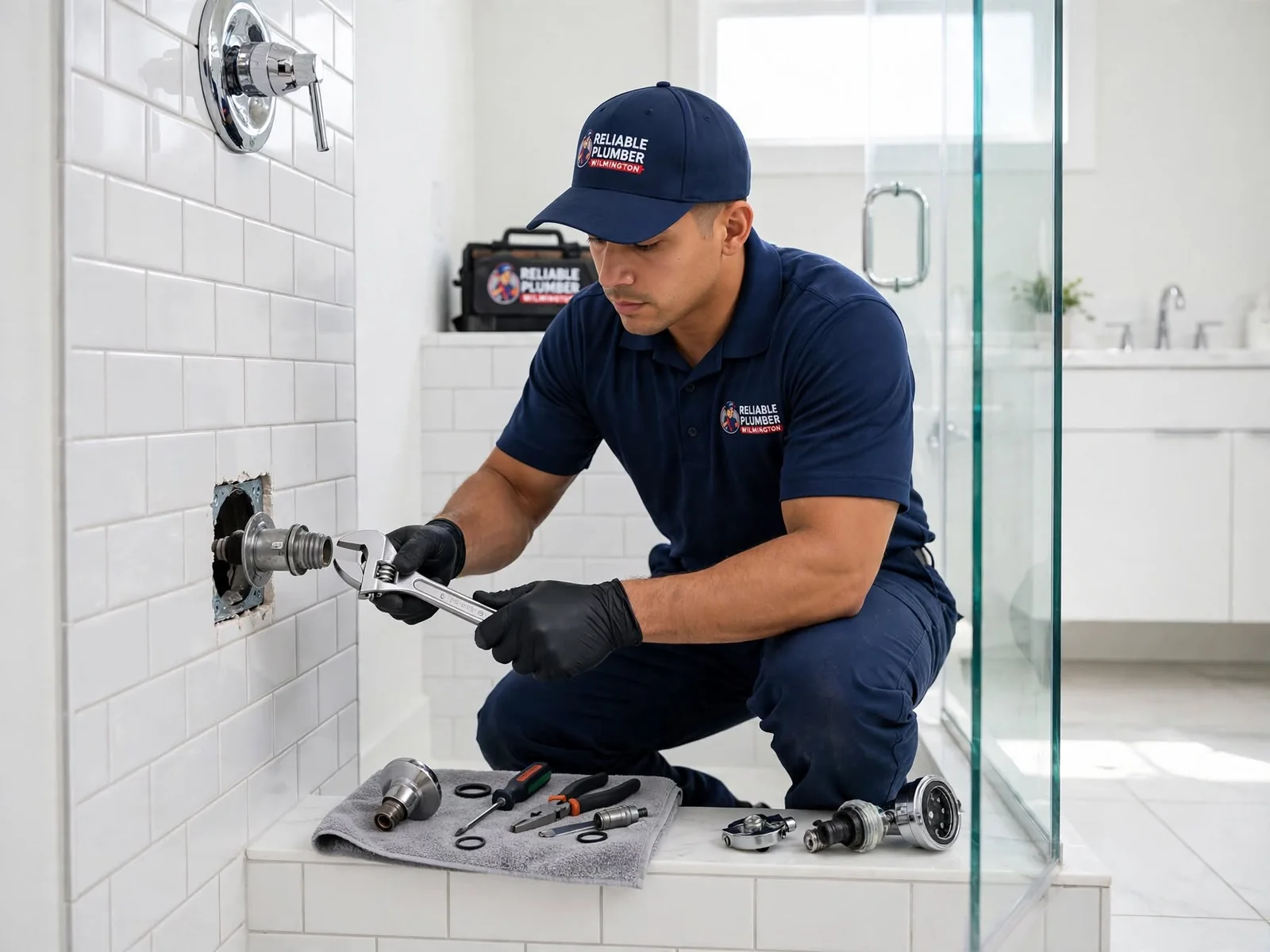
Because it is designed as a replaceable service part, all three are fixed by changing it - usually through the trim plate without disturbing tile.
Temperature Swings and What They Mean
Water going cold when a toilet flushes elsewhere is the classic pressure-balance symptom. Flushing draws cold water away, the hot-cold ratio at the shower shifts, and the temperature jumps.
A pressure-balancing valve is specifically designed to prevent that by compensating automatically. If yours does that and has stopped compensating, the cartridge is the likely cause.
If your shower has always done it, the valve probably has no pressure-balancing element at all - which places it before the current California requirement. That is a safety issue rather than a comfort one, and it means any replacement will be to the current standard rather than like-for-like.
Things That Are Not the Valve
A weak or uneven spray is usually the showerhead. Hard water builds deposit across the face and inside the nozzles, restricting and misdirecting flow. Unscrewing the head and soaking it in vinegar restores it - a ten-minute job requiring no plumber.
Damp appearing on a wall or the ceiling below is not a fixture fault at all. Water is escaping behind the wall, from a supply connection, the valve body itself, or failed waterproofing around the enclosure. That is leak detection followed by repair.
Low pressure across every fixture rather than just the shower is a supply problem - see water pressure repair. The fixture count is what separates the two.
When the Valve Really Does Need Replacing
A cracked or corroded valve body cannot be repaired by changing the cartridge, because the failure is the housing rather than the insert.
Obsolete valves are the other case. Where a shower is old enough that no cartridge is manufactured for it, there is nothing to fit and the valve has to be replaced regardless of its condition.
In both cases, the replacement is to current code: pressure-balancing, thermostatic or combination, meeting ASSE 1016 or ASME A112.18.1/CSA B125.1, capping water at the showerhead at 120°F. On a 1950s house that usually means opening the wall, which is why the full detail sits on shower installation.
References