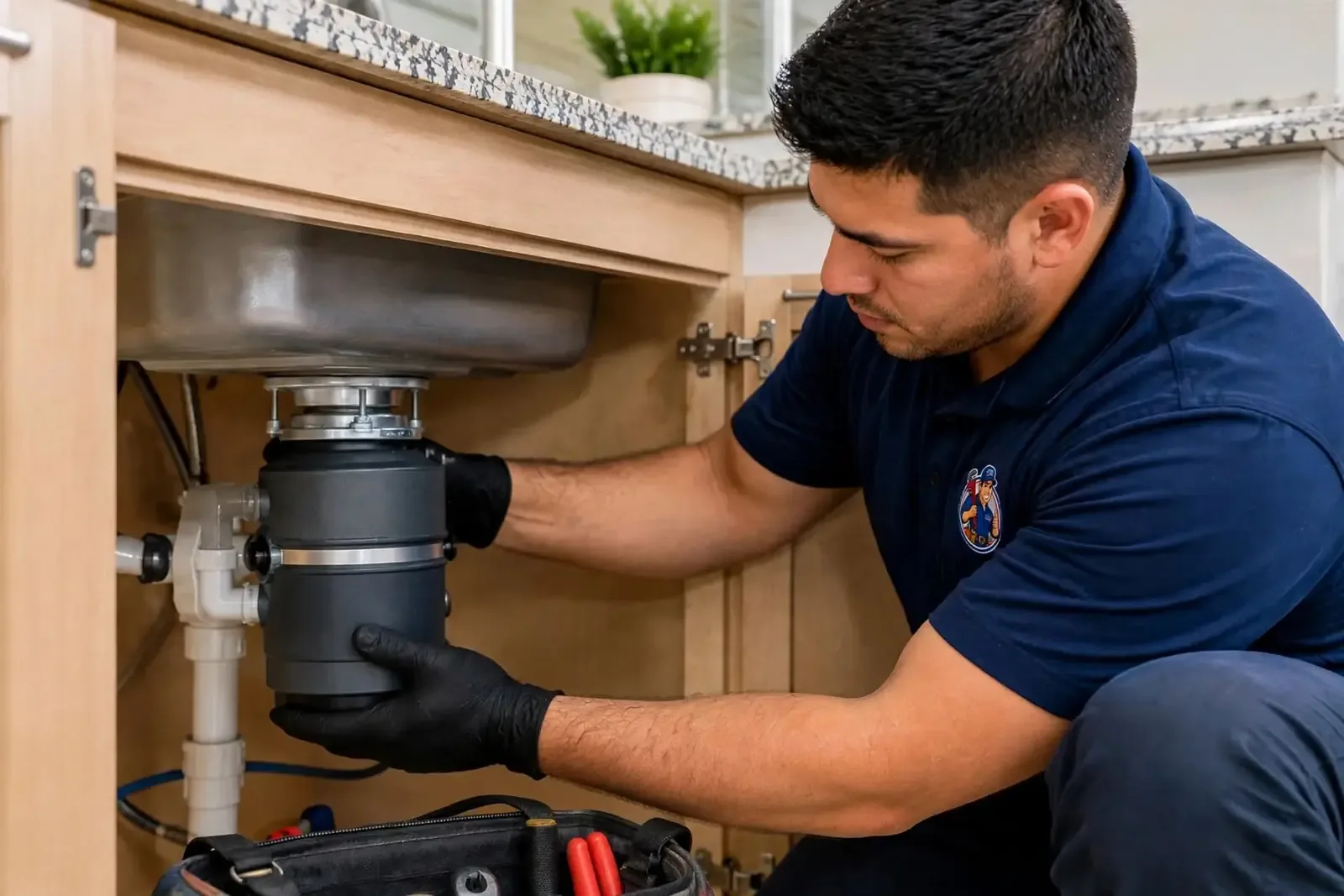
Garbage Disposal Installation in Wilmington, CA - The Complete Guide
Fitting a disposal is a straightforward job with one step that gets missed regularly and causes a service call within days.
Sizing It Honestly
Horsepower determines both how much waste a unit will handle and how readily it jams. A third HP is genuinely adequate for one or two people who cook occasionally. Half HP is the sensible default for an average household and is what most kitchens have.
Three-quarter and one HP units grind more effectively and jam less on fibrous waste, and they are generally better insulated for noise - which is a real quality-of-life difference in an open kitchen.
The failure mode of undersizing is not dramatic. It is a unit that jams every few months, which the owner experiences as an unreliable appliance rather than as a sizing decision made years earlier.
The Dishwasher Knockout
This is the classic installation miss, and it produces a very specific and very confusing symptom.
New disposals ship with the dishwasher inlet blocked by a knockout plug, because not every installation connects a dishwasher. If a dishwasher is being connected, that plug has to be removed before the hose is attached - and it has to be retrieved from inside the unit afterwards.
Leave it in place and the dishwasher cannot drain through the disposal. The dishwasher appears faulty, the disposal appears fine, and the actual cause is a small plastic disc that was never removed. It is worth asking specifically whether the knockout was taken out.
Mounting, Plumbing and Power
The mount fits the standard 3.5 inch sink drain opening, so most units are physically interchangeable. The sink flange is bedded with plumber's putty and secured with a mounting assembly, and the unit locks onto it.
Plumbing is the discharge tube to the trap, and the dishwasher hose where applicable. Both need to be properly supported so the weight of the unit is not carried on the connections.
Power is either a hardwired connection or a cord and plug into a switched outlet under the sink, depending on how the kitchen is wired. A first-time installation where no disposal existed may need that supply provided, which is what makes it more expensive than a replacement.
Think About the Drain Line First
A disposal does not reduce what goes into the drain - it reduces particle size and increases the volume of organic material entering the line. In a kitchen branch that is already coated with grease, that is more material meeting the same restriction.
In this housing stock the branch lines are typically ageing cast iron with internal scaling, which narrows the bore permanently. That is why kitchen blockages recur so reliably here and why fitting a powerful new disposal to a marginal line disappoints.
If the kitchen sink has a blockage history, deal with the line before or alongside the appliance. Drain cleaning covers clearing it, and where the blockage keeps returning hydro jetting removes the coating rather than boring a channel through it.
References