Most of Rancho Palos Verdes is ordinary hillside housing on the peninsula. Near the Portuguese Bend landslide it is not ordinary at all, and there one plumbing job matters more than any other: not putting water into the ground.











Rancho Palos Verdes incorporated on 7 September 1973 and covers the seaward side of the Palos Verdes Peninsula, with a population of around 42,287 and 16,723 housing units at a median construction year of 1967. It is the most owner-occupied place we serve, at roughly 80.4%. Water comes from California Water Service, which has supplied the peninsula since 1970 through its Palos Verdes system, also serving Palos Verdes Estates, Rolling Hills, Rolling Hills Estates and part of Lomita. The sewer arrangement is a hybrid worth knowing: the city owns around 150 miles of sewer main carrying flow from roughly 10,000 service connections to the treatment plant in Carson, but through annexation into a Sewer Maintenance District it is the Los Angeles County Public Works Department that operates and maintains those pipes. City-owned, county-run.
Then there is the landslide, and it needs stating carefully. The Greater Portuguese Bend Landslide Complex affects a defined part of the city - most of Rancho Palos Verdes sits well outside it and has entirely ordinary plumbing. Within it, the situation has been serious. The complex expanded from around 300 acres to over 700 acres from spring 2023, and through the wet years of 2022 to 2024 movement reached about a foot a week in places, damaging homes, roads and buried infrastructure. Southern California Gas cut natural gas service to 135 homes in the Portuguese Bend community in late July 2024, and Southern California Edison subsequently de-energised 140 homes indefinitely, with a further 105 in the Seaview area. Movement had slowed to an average of roughly 2.7 inches a week by December 2024, which the city attributed to drier weather and its own dewatering programme.
That dewatering programme is why plumbing matters here in a way it does not elsewhere. The city has been pumping groundwater out of the landslide through deep wells - well over half a billion gallons since autumn 2024, at a running cost of around $53,000 a month just for generators to power them - because groundwater is what drives the movement. Which means a leaking water service, a cracked sewer lateral or an over-running irrigation system on or near the slide is not merely a bill problem. It is water going into the exact place a great deal of public money is being spent taking water out. If you are in or near the affected area, a leak is worth finding quickly for reasons beyond your own property. Note also that the city adopted an ordinance in August 2025 restricting new residential construction in the landslide area, so anything beyond repair work should be checked with the City of Rancho Palos Verdes before it is planned.
Reliable Plumber Wilmington covers Rancho Palos Verdes from the harbour side of the peninsula. We handle drain cleaning, sewer line repair, leak detection, water heater work, repiping and everything alongside them - diagnosis before price, camera evidence on sewer work, and the finding written down.
Three authorities apply here rather than one: California Water Service for supply, Los Angeles County Public Works for the sewer mains it maintains on the city's behalf, and the City of Rancho Palos Verdes for permits. As an incorporated city, the LA City programmes do not reach it - no LASAN rebate, no LADWP adjustment. California requirements are unchanged statewide: SB 407 on fixtures during a remodel, the 80 psi pressure ceiling with a regulator above it, and seismic strapping on water heaters.
Peninsula properties sit on slopes, and gradient is the first thing we look at when a drain runs slowly. A line laid at too shallow a fall, or one that has shifted over the decades on a hillside lot, will collect material at a low point no matter how thoroughly it is cleared. A camera distinguishes that from an ordinary blockage, which is the difference between a cleaning and a correction.
Slow or blocked kitchen, bath, shower and laundry lines - and any drain that has already been cleared once and blocked again.

The sewer arrangement here is unusual: the city owns roughly 150 miles of main serving about 10,000 connections, but Los Angeles County Public Works operates and maintains them under a Sewer Maintenance District. Your lateral is still yours. On hillside lots and anywhere near known ground movement, we camera before scoping, because a joint that has been pulled apart by slope creep is a different repair from one that has simply corroded.
Recurring backups, several fixtures slow at once, sewer odour, or a line a camera has shown to be cracked, offset or root-invaded.

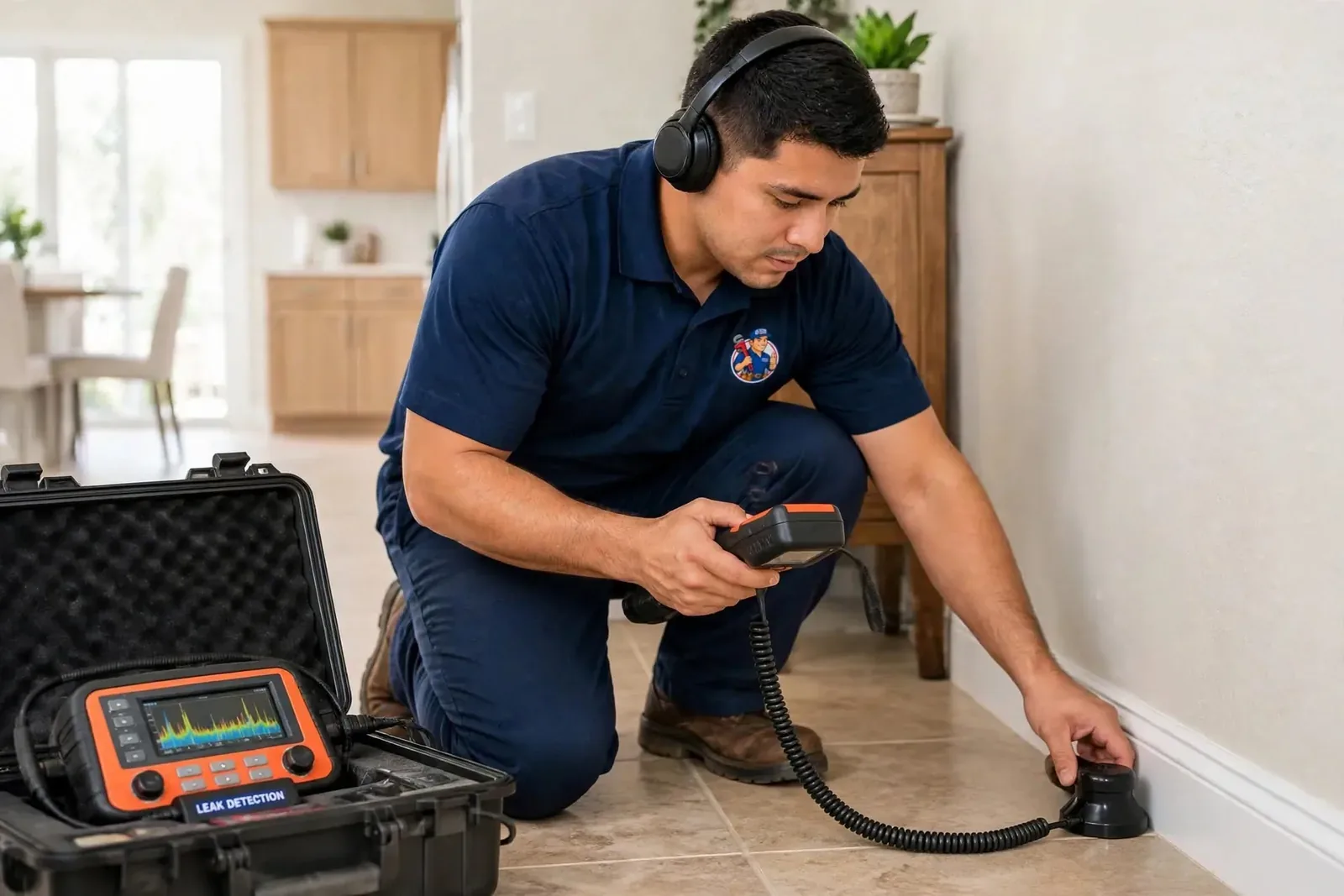
In most of the city this is conventional work - acoustic listening and thermal imaging to locate a hidden supply leak without opening more than necessary. On or near the Portuguese Bend landslide it carries extra weight, because groundwater is what drives the movement and the city is spending heavily to pump it out. A leak there is worth finding urgently for reasons that go beyond the water bill.
A water bill that jumped with no change in use, running water with every tap closed, a warm patch on the floor, or a stain with no obvious source.
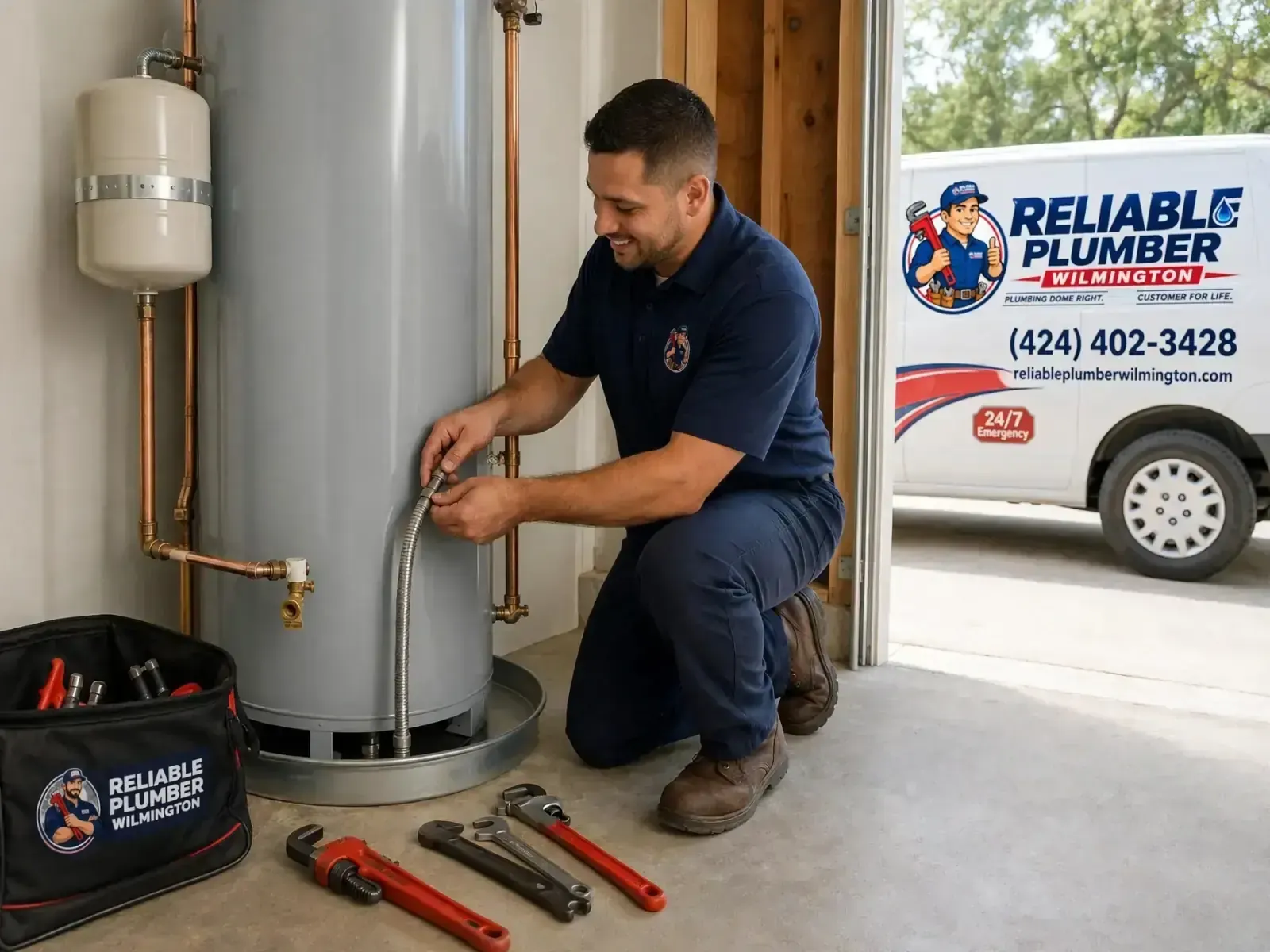
Permits come from the City of Rancho Palos Verdes. Requirements are California state code: two seismic straps at the upper and lower third anchored into framing rather than drywall, with the lower strap at least four inches above the gas control. Worth noting that strapping is about seismic movement specifically - a property affected by ground movement has separate considerations that we would raise with you directly.
No hot water, rumbling or popping, water pooling at the base, or a unit past twelve years old that is worth replacing on your schedule rather than its own.
A 1967 median puts much of the peninsula close to the galvanized-to-copper changeover, so the first job is identifying what is installed. Rust-tinted water with pressure down across the whole house points to galvanized past its service life; an isolated pinhole points to copper. On sloping lots we also pay attention to how supply lines are routed and supported, since a run that has been stressed by slope movement fails differently from one that has simply aged.
Rust-tinted water, pressure falling across the whole house, or a second and third leak on the same ageing supply system.

Hillside construction here includes slab, raised and split-level foundations, so we confirm which you have before anything else. Where a slab leak is present the usual signals apply - a warm patch, an unexplained bill, water audible with everything closed - and precise acoustic and thermal location keeps the concrete work proportionate. On ground known to move, we also look at whether the failure has a cause worth addressing rather than just a location.
A warm patch on the floor, water audible with every fixture closed, or an unexplained bill increase on a slab-on-grade property.

Pressure is set from the camera. Sound lateral takes 2,500 to 3,000 PSI; older or compromised pipe is run at 1,500 to 2,000 PSI instead. On a hillside, where a line has separated at a joint rather than simply blocked, jetting is the wrong tool and we will tell you so rather than clearing it and leaving the underlying problem in place.
Blockages that keep returning, kitchen lines with a grease history, and scaled cast iron where cabling only bores a channel.

At around 80.4% owner-occupied, Rancho Palos Verdes has the highest ownership rate anywhere we work, so fixture decisions are almost always made by the person in the house. On anything predating 1994 the case is straightforward: 3.5 gallons a flush or more against California's 1.28 gallon standard, and SB 407 brings replacement into scope during a remodel.
Running or phantom-flushing toilets, weak flush, water seeping at the base, or replacing a pre-1994 fixture using 3.5 gallons a flush.

Water comes from California Water Service's Palos Verdes system, which has served the peninsula since 1970, and its mineral content shortens cartridge and valve seat life beyond what manufacturer guidance assumes. Where a tap has been rebuilt once already and started dripping again inside a couple of years, that is the likeliest explanation rather than a fault in the work.
Dripping spouts, stiff handles, leaking handle bases, or flow that has dropped at one fixture while the rest of the house is fine.

Tell the dispatcher your street and whether you are near the Portuguese Bend or Seaview areas, because conditions and access there differ from the rest of the city. Shut the main off first. If water is escaping into the ground rather than into the house, say so plainly - on this part of the peninsula that changes how urgently it needs dealing with.
Burst supply lines, sewage backing up, main line breaks, and water heater failures - anything where water is causing damage right now.

Covering a city properly means knowing what changes at its boundary. Here, several things do.
The city has pumped over half a billion gallons out of the Portuguese Bend landslide since autumn 2024 because groundwater drives the movement. A leaking service or lateral near the slide puts water back in, which makes finding it urgent.
City dewatering programmeOn hillside lots a slow drain is often gradient or a joint pulled apart by slope creep rather than a blockage. Jetting the wrong problem clears nothing, and we will say so rather than take the easy job.
Camera before scopingThe city owns around 150 miles of main serving about 10,000 connections, but Los Angeles County Public Works maintains them under a Sewer Maintenance District. Knowing who is responsible for what saves days.
City-owned · county-maintainedRancho Palos Verdes adopted an ordinance in August 2025 restricting new residential construction in the landslide area. Anything beyond repair should be confirmed with the city, and we will tell you that rather than guess.
Confirm with City of RPVCamera footage on sewer recommendations, acoustic and thermal on hidden leaks, findings written down. Where ground conditions are part of the diagnosis, you should see what that judgement rests on.
Camera · written findingsRancho Palos Verdes runs along the seaward face of the peninsula, and conditions vary considerably across it.
The great majority of Rancho Palos Verdes - Miraleste, Eastview, Del Cerro, Grandview, Crestridge and the neighbourhoods along Hawthorne Boulevard - is conventional hillside housing at a 1967 median construction year, where the plumbing questions are the ordinary ones about pipe age, slope and gradient. Portuguese Bend, Seaview and the Abalone Cove area are the exception. The Greater Portuguese Bend Landslide Complex grew from about 300 acres to more than 700 from spring 2023, and during the wet years that followed movement reached roughly a foot a week in places before slowing to an average of about 2.7 inches a week by December 2024. Gas service was cut to 135 homes in Portuguese Bend in July 2024 and power was disconnected indefinitely to 140 homes there, with a further 105 in Seaview. If you are in those areas, conditions on your street are the first thing to tell us about.
Licensed, bonded and insured · 24/7 dispatch · diagnosis before price · findings in writing
Five categories covering everything from a slow drain to a full repipe.
We reach Rancho Palos Verdes from Wilmington 90744, and cover 30 cities across Los Angeles County and north Orange County. These are the communities closest to Rancho Palos Verdes.
Coverage, permits, water and what is specific to this city.
Yes, across the peninsula - Miraleste, Eastview, Del Cerro, Grandview, Crestridge and the neighbourhoods along Hawthorne Boulevard, as well as the Portuguese Bend and Seaview areas. We come up from the harbour side, so it is a short run.
No, and that is worth being clear about. The Greater Portuguese Bend Landslide Complex affects a defined part of the city. Most of Rancho Palos Verdes sits well outside it and has entirely ordinary plumbing conditions.
Because groundwater is what drives the movement, and removing it is the city's main mitigation. Deep dewatering wells have pumped well over half a billion gallons out of the landslide since autumn 2024, at a running cost of around $53,000 a month just to power them. A leaking water service, a cracked sewer lateral or an over-running irrigation system puts water back into the ground the city is paying to drain, so finding it quickly matters beyond your own bill.
Southern California Gas cut natural gas service to 135 homes in the Portuguese Bend community in late July 2024 because of the land movement, and Southern California Edison subsequently de-energised 140 homes indefinitely, with a further 105 in the Seaview area. Movement had slowed to an average of around 2.7 inches a week by December 2024, down from roughly a foot a week at its peak.
Check with the City of Rancho Palos Verdes before planning anything, because the position changed. The city adopted an ordinance in August 2025 restricting new residential construction in the landslide area, including additions. Repair work is a different category from new construction, but we would not want you to rely on our reading of it - the city is the right authority to confirm.
California Water Service, which has served the Palos Verdes Peninsula since 1970 through its Palos Verdes system. That same system also covers Palos Verdes Estates, Rolling Hills, Rolling Hills Estates and part of Lomita.
It is a split arrangement. The city owns roughly 150 miles of sewer main carrying flow from about 10,000 service connections to the treatment plant in Carson, but through annexation into a Sewer Maintenance District the Los Angeles County Public Works Department operates and maintains those pipes. Your own lateral remains your responsibility.
Often gradient rather than a blockage. A line laid at too shallow a fall, or one whose joints have been pulled or shifted by slope movement over the decades, collects material at a low point regardless of how often it is cleared. A camera tells the two apart, and it matters because jetting will not fix a pipe that has moved.