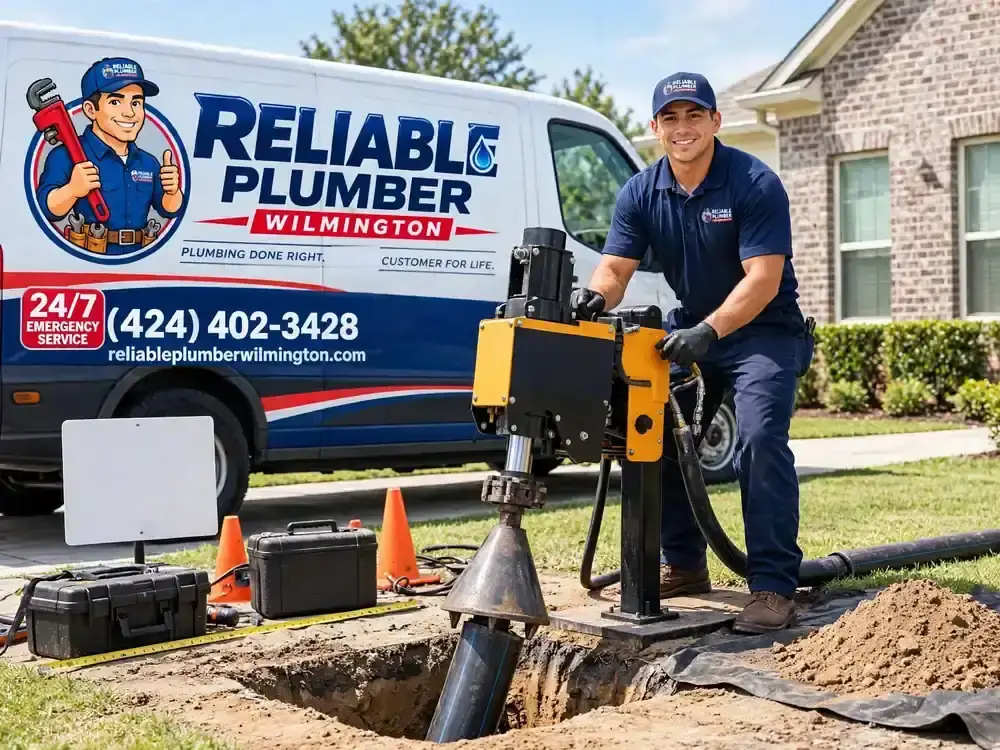
Trenchless Sewer Repair in Wilmington, CA - The Complete Guide
Trenchless replaced the assumption that a failed sewer lateral means losing your garden for a week. It did not replace the need to establish what is actually wrong first.
What "Trenchless" Actually Means
Conventional replacement excavates the full length of the lateral, lays new pipe, and backfills. The plumbing is often the smaller part of that job - reinstating driveway, hardscape, planting or roadway routinely dominates the cost.
Trenchless methods work through access pits at either end of the run rather than a continuous trench. The ground between them is largely undisturbed, which is where the saving comes from and why the comparison depends so heavily on what is above your pipe.
CIPP Lining in Practice
A flexible tube saturated with resin is drawn into the cleaned host pipe and inflated against its walls, then cured to form a rigid pipe within a pipe. The result is jointless along its length, which matters because joints are where cast iron laterals typically fail and where roots enter.
Two limitations decide most cases. The liner conforms to the existing pipe, so it cannot correct a belly or a misalignment - geometry in, geometry out. And it slightly reduces internal diameter, which on a residential lateral is usually acceptable but is a real consideration on a line already marginal for its load.
It also needs a host pipe sound enough to support the liner during installation. That is the constraint people are most often surprised by, because it means the worst-condition lines are the ones lining cannot help.
Pipe Bursting in Practice
A bursting head is pulled through the existing line, fracturing it outward into the surrounding soil while drawing new pipe in behind it. Because the old pipe is destroyed rather than reused, its condition is far less limiting.
The distinctive advantage is diameter. Lining can only reduce internal size; bursting maintains the nominal size and in many cases allows upsizing by one or more pipe sizes, subject to soil conditions and how close adjacent utilities sit. Where a lateral has always been marginal, that is a genuine improvement rather than a like-for-like replacement.
The full method, and when upsizing is worth doing, is covered on pipe bursting.
How the Decision Gets Made
It starts with camera footage. That establishes the material, the defects, their positions, and critically whether there is a belly.
Site conditions come next: where access pits can go, what sits above the run, how deep it is, and what other utilities share the corridor. Bursting in particular is sensitive to what is immediately adjacent.
Only then does method selection make sense. A contractor who quotes a trenchless method before running a camera is quoting a preference, and you should ask what the recommendation is based on. Where neither method is viable, conventional replacement is the honest answer rather than a failure.
References