
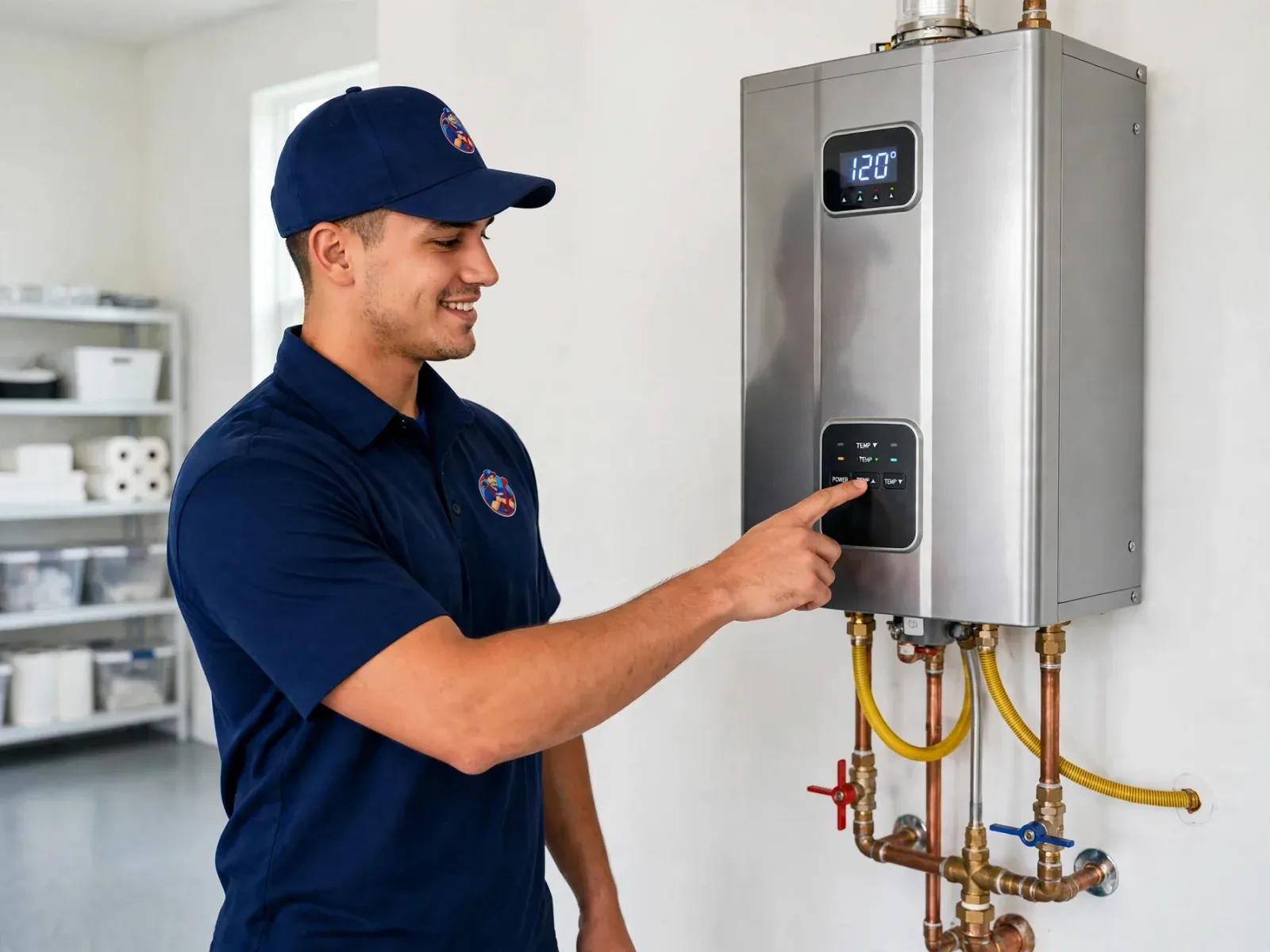
A water heater usually tells you it is finishing before it fails outright. Rust-coloured hot water, a rumbling or popping noise from the tank, water pooling at the base, and an age past ten years are the four signals that matter most. Any one of them is worth investigating; two or more together generally means you are looking at a replacement rather than a repair.
The part most guides leave out is what a replacement actually involves here. A new heater in the City of Los Angeles has to meet current code, which usually means seismic strapping, often an expansion tank, and a low-NOx unit that may need different venting than the one coming out. That is why a replacement quote is rarely just the price of the tank.
What's In This Guide
The Short Answer
- Replace if the tank itself is leaking. A leaking tank cannot be repaired.
- Replace if hot water runs rusty and cold water does not.
- Strongly consider replacing past 10 to 12 years, especially if a significant repair is being quoted.
- Repair is usually reasonable for a failed thermostat, element, or thermocouple on a younger unit.
The Seven Signs
Rusty or Brown Hot Water
Run the hot tap, then the cold. If only the hot side is discoloured, the rust is coming from inside the tank, which means the glass lining has failed and the steel underneath is corroding.
If both sides are discoloured, the problem is more likely the supply pipework rather than the heater.
Hot-only discolouration is a replacement signal. Corrosion inside the tank is not repairable.
Rumbling, Popping or Banging From the Tank
Sediment settles at the bottom of the tank and hardens into a layer. The burner then has to heat through that layer, and water trapped underneath boils and forces its way out, which is the popping sound.
Beyond the noise, the sediment insulates the water from the burner, so the unit works harder for the same output and the tank bottom overheats.
Early on, flushing helps. Once the layer has hardened, flushing will not shift it.
Water Pooling Around the Base
First rule out the fittings, the temperature and pressure relief valve, and the drain valve, because all three are repairable and all three can drip.
If the tank body itself is weeping, the unit is finished. Steel tanks do not get patched.
A leaking tank body is the one sign that admits no repair option.
Hot Water Runs Out Faster Than It Used To
Sediment takes up volume that used to be water, so the effective capacity of the tank shrinks over time. A 40-gallon tank with a thick sediment layer delivers noticeably less than 40 gallons of hot water.
A failed lower element on an electric unit produces the same symptom and is repairable, so this one is worth diagnosing rather than assuming.
Worth a diagnostic. The cause determines whether this is a repair or the end of the unit.
Temperature That Will Not Hold Steady
Water that swings between scalding and lukewarm usually points at a thermostat, a failing element, or a dip tube problem.
On a younger heater these are ordinary repairs. On an older one they are often the first of several failures.
Repairable in itself - the question is the age of the unit it is happening on.
Visible Corrosion on the Tank or Fittings
Rust on the outside shell, around the inlet and outlet connections, or on the base is a sign the unit is deteriorating from outside as well as inside.
Corrosion around the connections can also mean a slow leak has been running for a while.
Have it looked at rather than left. Slow leaks are cheap to fix and expensive to ignore.
Age Past Ten Years
Age on its own is not a fault, and plenty of well-maintained heaters run well beyond ten years. But past that point the economics shift: money spent on a repair is money spent on a unit with limited remaining life.
Check the manufacture date on the rating plate rather than guessing. Most manufacturers encode it in the serial number.
Past 10 to 12 years, weigh any significant repair quote against the cost of replacing.
How Much Age Really Matters
The practical rule is to compare the repair quote against the remaining life you are buying. A $200 repair on a six-year-old heater is straightforward value. The same repair on a thirteen-year-old unit buys an unknown amount of time on a tank that is already past its typical span, and it does nothing about the sediment that is the underlying problem.
Why Local Water Shortens the Life
Supply in this region runs roughly 7 to 16 grains per gallon, with the harder end of that range reaching the harbor communities. Harder water drops more mineral out of solution as it is heated, so sediment accumulates faster than it would in a soft-water area.
That has two consequences. Tanks here tend to reach the rumbling stage earlier, and annual flushing does more good here than it would elsewhere - provided it is done before the sediment layer hardens. Once it has set, flushing is no longer effective.
Not Sure Whether to Repair or Replace?
A diagnostic visit establishes the age, the condition of the tank and whether the fault is repairable. We handle water heater repair and water heater replacement across the harbor area, and we are licensed, bonded and insured.
Call (424) 402-3428Repair or Replace
| Symptom | Usually |
|---|---|
| Tank body leaking | Replace - not repairable |
| Hot water rusty, cold water clear | Replace - internal corrosion |
| Failed thermostat or heating element | Repair, if the unit is under about 10 years |
| Failed thermocouple or pilot assembly | Repair |
| Rumbling from hardened sediment | Replace if severe, flush if caught early |
| Dripping T&P relief valve | Repair - but find out why it is relieving |
| No hot water, unit over 12 years | Usually replace |
What Replacement Costs Here
These are Los Angeles ranges for 2026, useful for sanity-checking a quote rather than as an estimate for your property.
| Work | Typical LA range |
|---|---|
| Water heater repair | from around $125 |
| Tank water heater, supplied and installed | $1,140 - $2,410 (around $1,740 typical) |
| Code-compliant 50-gallon gas installation | $2,200 - $3,500 |
| Tankless installation | $1,616 - $3,829 (around $2,668 typical) |
| Venting work where required | $200 - $600 |
| Permit (tank / tankless) | reported around $125 / $175 |
The gap between the bare unit price and the installed code-compliant price is where the local requirements sit: seismic strapping, an expansion tank where the system is closed, and a low-NOx unit whose venting may not match what is being removed. A quote that is materially below these ranges is worth questioning on exactly those points.
When It Is Not a Planning Decision
| Situation | Do this now |
|---|---|
| Water actively pooling around the tank | Shut off the water supply to the heater and the gas or breaker to it. |
| You smell gas near the unit | Do not operate switches. Leave the building, then call 911 and the gas utility from outside. |
| Relief valve discharging steadily | A pressure or temperature fault, not a nuisance drip. Get it looked at. |
| Tank scalding despite a normal setting | Turn the thermostat down and get it looked at. |
Frequently Asked Questions
Most tank heaters are considered to be at the end of their typical span somewhere around 10 to 12 years, though a well-maintained unit can run longer. Hard water shortens it by accelerating sediment build-up, and this region sits toward the harder end of the supply range.
That points at corrosion inside the tank - the glass lining has failed and the steel beneath is rusting. It is not repairable, so it is a replacement signal. If both hot and cold run discoloured, the cause is more likely the supply pipework than the heater.
Sediment has settled and hardened on the bottom of the tank. The burner heats through that layer and water trapped underneath boils and escapes, which produces the popping or rumbling. Caught early, flushing helps. Once the layer has hardened, flushing will not remove it.
It depends on where the leak is. Fittings, the drain valve and the temperature and pressure relief valve are all repairable. If the tank body itself is leaking, the unit has to be replaced - steel tanks are not patched.
Weigh the repair cost against the remaining life you are buying. A small repair may be reasonable. A significant one on a unit past twelve years is usually money spent on a tank that is close to the end anyway, and it does not address sediment build-up.
Because a replacement has to meet current code. In practice that generally means seismic strapping, an expansion tank where the system is closed by a pressure reducing valve, and a low-NOx unit for this air district whose venting requirements may differ from the unit being removed. A permit is also required.
Yes, if it is done before the sediment hardens. Annual flushing is more worthwhile here than in soft-water areas because more mineral drops out of the supply. Once a hard layer has formed on the tank bottom, flushing no longer shifts it and the benefit is largely gone.