
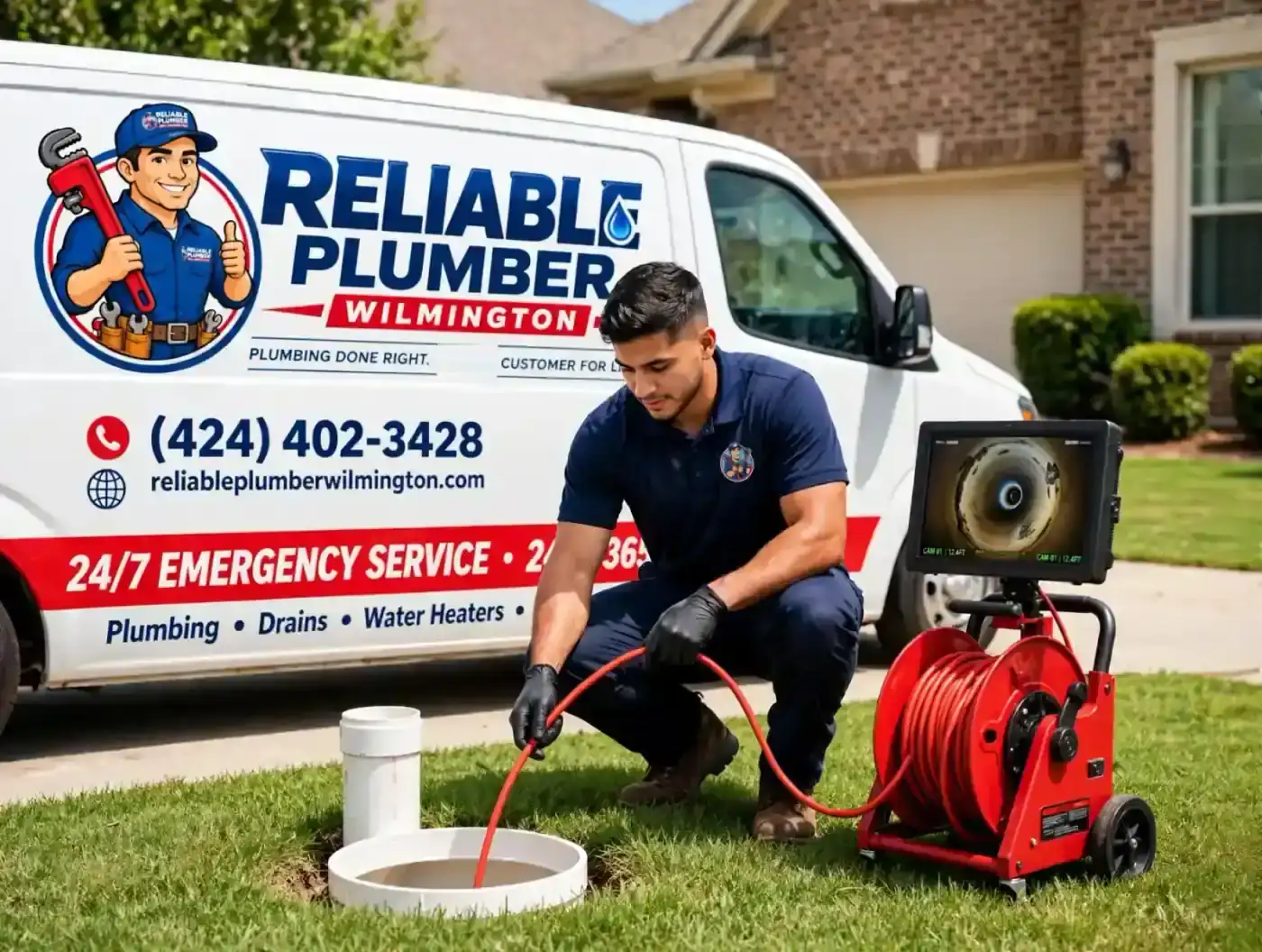
In the City of Los Angeles, the property owner owns the sewer lateral for its entire length - from the house, across the parkway, under the kerb, and out to the point where it joins the public sewer main, which is usually in the middle of the street. Ownership does not stop at the property line or at the sidewalk. If that pipe cracks, sags or fills with roots anywhere along that run, the repair is the owner's responsibility and the owner's bill.
Wilmington sits inside the City of Los Angeles, so this rule applies here in full. It catches people out constantly, because in many other cities the utility takes over at the property line. Below is what the rule actually says, why the local housing stock makes it expensive, the permit you will need before anyone digs in the street, and the rebate programme that a lot of owners never hear about.
What's In This Guide
The Short Answer
LA Sanitation and Environment (LASAN) maintains the public sewer main. Everything between your fixtures and that main is the private sewer lateral, and it belongs to the property. That includes the section running under public ground - the parkway, the sidewalk and the roadway itself - right up to the connection at the main.
Upper Lateral vs Lower Lateral
The lateral is usually described in two parts, and knowing which one has failed changes the scope of the work more than anything else.
The Upper Lateral
The run from the building to the property line, entirely on private ground. This is the accessible half. It is where the cleanout normally sits, where root intrusion is most often caught first, and where a repair can usually be done without touching the road.
Generally the cheaper half to repair - open trench in a yard or under a driveway, no traffic control.
The Lower Lateral
The run from the property line to the sewer main under the street. Same owner, very different job. Work here means excavating public right of way, which brings a permit, traffic control, restoration of the roadway surface, and inspection.
Trenchless methods matter most here - repairing without a full street excavation is often the difference between a manageable bill and a very large one.
Why the Rule Costs Owners Money
Three consequences follow from owning the whole run, and they compound.
| Consequence | Why it follows |
|---|---|
| Insurance usually will not cover it | Gradual failure - roots, corrosion, a pipe settling over decades - is typically excluded as wear rather than sudden damage. Cover for sewer lines is often a separate endorsement, so check your own policy wording. |
| You cannot simply hire anyone | Work in the public right of way requires a permit, and the permit requires a contractor who is licensed and bonded for that work. |
| Cost is driven by where the fault is | Not by how bad it is. A small crack under the roadway can cost more to reach than a badly collapsed section in a front yard. |
Why Local Laterals Fail
Most housing here was built between 1940 and 1969. Laterals from that era are typically cast iron or vitrified clay, and both are now past or near the end of their service life. Cast iron lasts roughly 50 to 100 years and tends to fail at the joints first, scaling internally and then cracking. Clay is durable in itself but joints between sections open as ground shifts.
Those open joints are what roots find. Root intrusion is the leading cause of lateral blockages across Los Angeles, and the usual culprits are the street trees - ficus and sycamore in particular - whose roots follow moisture to a joint and then widen it. A lateral does not need to be broken for roots to enter. A joint that has moved a few millimetres is enough.
The S-Permit You Will Need
Any work on the sewer lateral in the public right of way needs an S-Permit from the Los Angeles Bureau of Engineering. Your contractor normally pulls it. Major structural work - significant cracks, offset joints, heavy root intrusion or a collapsed section - falls under a supplemental S-Permit rather than the standard one.
This is worth knowing before you get quotes, for one practical reason: a quote that does not mention permitting or restoration for a job under the street is probably incomplete. Ask which permit the job needs and who is pulling it.
The LASAN Rebate
LA Sanitation operates a rebate programme for private sewer lateral repair, reported at up to $2,500, with the work carried out by a licensed and bonded contractor. It exists because failing private laterals leak into and overload the public system, so the city has its own reason to want them fixed.
Not Sure Which Half of the Lateral Has Failed?
A camera inspection answers the ownership question and the scope question in one visit. We provide sewer camera inspection and sewer line repair across the harbor area, and we are licensed, bonded and insured for work in the public right of way.
Call (424) 402-3428How to Find Out What You Are Dealing With
- Note the pattern. One slow fixture is a local problem. Several fixtures backing up together, or a toilet that gurgles when you run a sink, points at the main line or the lateral.
- Find your cleanout. Usually a capped pipe near the building line or in the front yard. It is the access point for both inspection and clearing, and knowing where it is saves time on every future visit.
- Get the line cleared enough to pass a camera. A camera cannot read through standing water and debris.
- Camera the full run. This is the step that matters. It locates the fault by distance from the cleanout, which tells you whether it sits in the upper lateral or past the property line.
- Get the depth and location marked. Depth drives the cost of any excavation and determines whether a trenchless repair is workable.
- Decide between spot repair and lining or replacement based on how much of the run is compromised, not just where today's blockage is.
What Repairs Cost
The figures below are typical Los Angeles ranges for 2026 and are given so you can sanity-check a quote. Your own price depends on depth, surface type, length of the run and whether the work is under the roadway - so treat these as a range, not an estimate for your property.
| Work | Typical LA range |
|---|---|
| Main line clearing | $500 - $860 |
| Hydro jetting | $350 - $600, and above $1,000 where roots are established |
| Sewer camera inspection | $100 - $300 |
| Service call / diagnostic visit | $75 - $150 |
| After-hours or emergency call-out | $200 - $400 (typically 1.5x to 2x standard) |
Excavation and replacement sit well above these and vary too widely with depth and surface to quote as a range. That is exactly why the camera inspection comes first: it is the cheapest step in the list and it is the one that determines everything after it.
Frequently Asked Questions
No. In the City of Los Angeles the property owner owns the lateral for its whole length, out to the connection with the public sewer main in the street. LA Sanitation maintains the main itself. This is different from many other cities, where responsibility transfers at the property line.
The property owner. Ownership does not change because the pipe sits under public ground. What does change is the process: work in the right of way needs an S-Permit from the Bureau of Engineering, traffic control, and restoration of the road surface afterwards, which is why these repairs cost more than the same fault in a front yard.
Often not. Standard policies commonly exclude gradual deterioration - root intrusion, corrosion and settling all fall into that category - and cover for sewer lines is frequently sold as a separate endorsement. Read your own policy wording or ask your insurer directly, because terms vary between policies.
The upper lateral runs from the building to the property line and sits entirely on private ground. The lower lateral runs from the property line to the sewer main under the street. Both belong to the owner. The distinction matters because work on the lower lateral requires permitting and roadway restoration, which the upper lateral usually does not.
A camera inspection is the only way to be certain, but the pattern is a strong hint: a line that clears and then blocks again on a repeating cycle is usually catching debris on something structural, and in Los Angeles that is most often roots at an open joint. Street trees such as ficus and sycamore are the common source.
Not in the public right of way. That work requires a permit, and the permit requires a licensed and bonded contractor. Work on the private portion is also worth thinking carefully about, because a repair that fails an inspection or damages the connection at the main becomes a much larger job.
LA Sanitation runs a rebate programme for private lateral repair, reported at up to $2,500 where the work is done by a licensed and bonded contractor. Programme terms and funding change, so confirm the current rules with LA Sanitation before you commit to the work, and ask whether the application has to be filed before the repair begins.
It is normally the other way round. A camera cannot see through standing water and heavy debris, so the line is usually cleared enough to give the camera a clear run, then inspected. The inspection is what locates the fault and its depth, which is what any sensible repair quote is built on.