
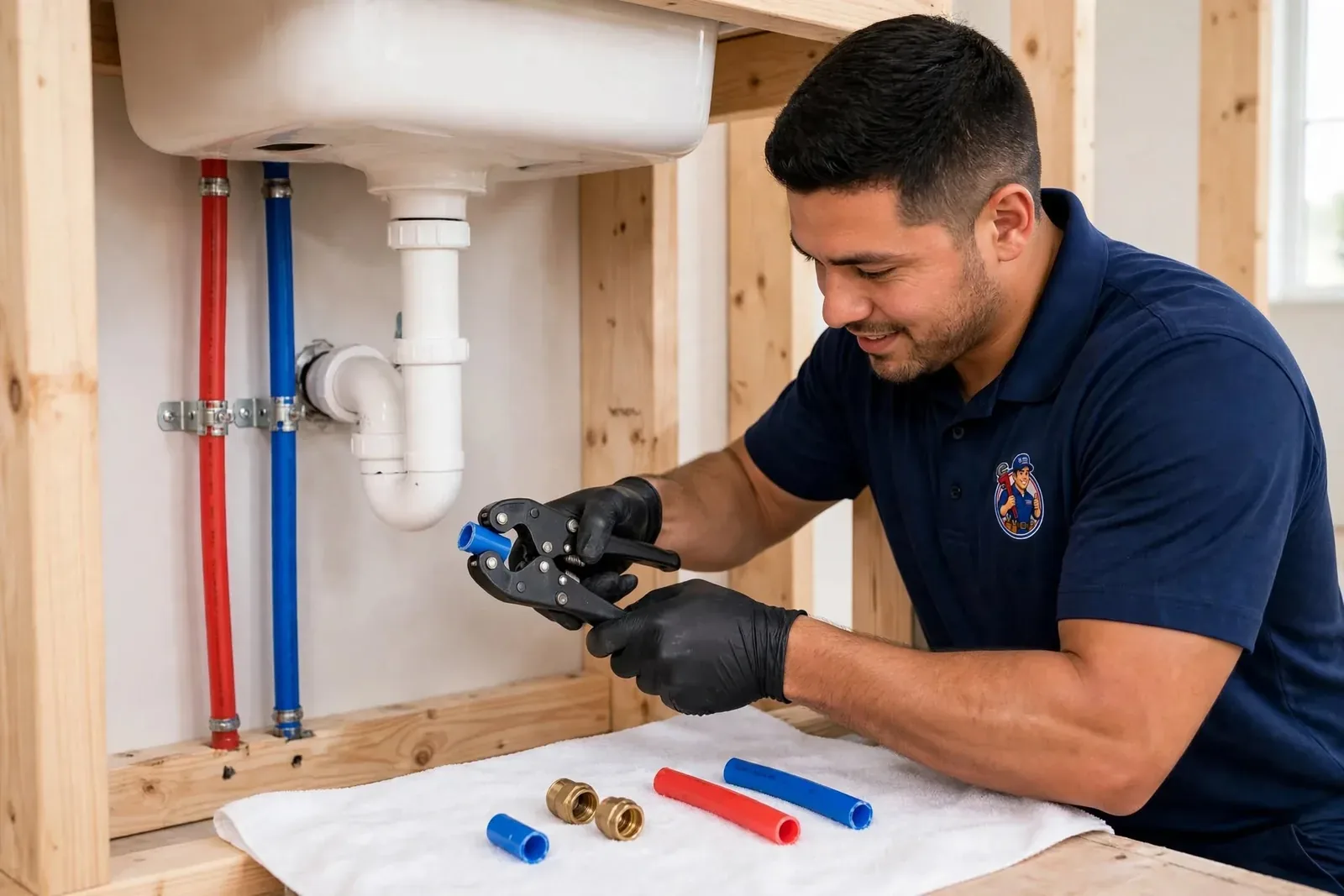
Galvanized steel was the standard water supply pipe in American homes until around 1980, and it has a service life of roughly 30 to 40 years. Most of the housing stock in Wilmington was built between 1940 and 1969. Put those two facts together and any original galvanized supply line still in service is somewhere around 60 to 85 years old, which is roughly double what it was designed for.
That gap explains most of what people notice: pressure that has faded so gradually nobody registered it, discoloured water on the first draw of the morning, and pinhole leaks that start appearing in clusters rather than one at a time.
What's In This Guide
The Arithmetic
| Figure | |
|---|---|
| Galvanized steel design life | 30 to 40 years |
| Typical Wilmington build era | 1940 to 1969 |
| Age of original pipe today | roughly 60 to 85 years |
| Position against design life | about double |
This is not a prediction that a given house has failing pipe. Plenty of properties were repiped decades ago, and plenty of others have had sections replaced piecemeal. But if a house of this era still has its original supply lines, the pipe is well past the point where failure is a question of when rather than whether.
How Galvanized Pipe Actually Fails
Galvanized pipe is steel with a protective zinc coating on the inside. The zinc is sacrificial - it corrodes first, protecting the steel underneath. That works until the zinc is used up.
The Zinc Depletes
Water passing through the pipe gradually strips the zinc layer. This is slow and produces no symptoms at all. The pipe looks and behaves normally throughout.
Nothing to see and nothing to do at this stage - it is simply the clock running.
The Steel Starts to Rust
With the zinc gone, water reaches bare steel and rust forms on the inside wall. Rust occupies more volume than the steel it came from, so the deposit builds inward and the bore narrows.
This is where pressure begins to drop - so gradually that most households adapt without noticing.
The Bore Chokes
Scale accumulates until the internal diameter is a fraction of what it was. A half-inch line can end up passing water through an opening closer to the width of a pencil. Flow at the fixture collapses, particularly when two outlets run at once.
By this point the pipe cannot be restored - the lost bore is not recoverable by cleaning.
The Wall Perforates
Corrosion works outward as well as inward. Eventually it breaches the wall and produces a pinhole leak. Because the whole run has aged under the same conditions, the first pinhole is usually followed by others within a fairly short period.
A cluster of pinholes in a short space of time is the signal that the run has reached the end, not that you were unlucky.
Why Local Water Makes It Worse
LADWP supply in this region runs roughly 7 to 16 grains per gallon, and the harder end of that range corresponds to the Colorado River share, which weighs more heavily toward the harbor end of the system that serves Wilmington and the neighbouring port communities. Harder water accelerates scale formation inside the pipe.
So the same galvanized pipe installed in a softer-water area would be in better condition at the same age. Mineral scale layers onto the rust deposit and narrows the bore faster, which is one reason pressure complaints in older properties here tend to be more pronounced than the age of the pipe alone would suggest.
The Symptoms, in the Order They Appear
| Symptom | What it tells you |
|---|---|
| Brown or rust-tinted water on first draw | Sediment that settled overnight, clearing after a few seconds. The earliest reliable sign. |
| Pressure drops when a second outlet opens | Restricted bore rather than a fixture problem - a shower fading when a kitchen tap runs. |
| Hot side worse than cold | Heat accelerates corrosion, so hot lines usually choke first. |
| Uneven pressure between fixtures | Fixtures furthest along the run suffer first. |
| Visible rust staining at threaded joints | Threads cut into the pipe wall, so it is thinnest there and joints weep before straight runs do. |
| Pinhole leaks appearing in clusters | The end stage. The whole run has aged under the same conditions. |
How to Identify Galvanized Pipe
- Find exposed pipe - usually at the water heater, under sinks, in a garage, or where the supply enters the building.
- Look at the colour. Galvanized is dull silver-grey. Copper is unmistakable. PEX is plastic tubing, commonly red, blue or white.
- Try a magnet. It sticks to galvanized steel. It does not stick to copper or plastic. This is the quickest single test.
- Look at the joints. Galvanized uses threaded fittings. Copper is soldered or pressed. Threaded steel fittings on supply lines in a mid-century house are a strong indicator.
- Scratch a clean spot lightly. Grey underneath suggests galvanized; a bright orange-pink metal is copper.
- Check whether it is consistent throughout. Partial past repipes are common, so finding copper at one fixture does not mean the whole house is copper.
Losing Pressure in an Older Property?
Pressure loss has several possible causes and old pipe is only one of them. We diagnose before recommending anything, and handle whole-home repiping and water pressure repair across the harbor area.
Call (424) 402-3428The Low-Pressure Trap
Low pressure gets blamed on old pipe more often than it should be. Before accepting a repipe quote on the strength of pressure alone, it is worth ruling out the cheaper causes, because they are common and they are fixable in an afternoon.
The California Plumbing Code caps static supply pressure at 80 psi, and where incoming pressure exceeds that, a pressure reducing valve is required. That valve is on the owner's side of the meter and the owner maintains it. A failing PRV is a very ordinary cause of poor pressure throughout a property, and it presents much like a choked supply line.
Repair, Partial Repipe or Full Repipe
Spot Repair
Cutting out a failed section and replacing it. Reasonable for an isolated failure on an otherwise sound system, or as a stopgap.
On a run that has reached the pinhole stage, spot repairs tend to be a treadmill: the rest of the pipe is the same age and the same condition.
Sensible when the failure is genuinely isolated. Poor value when pinholes are appearing in clusters.
Partial Repipe
Replacing the worst runs - commonly the hot side, or the sections feeding the fixtures with the worst flow - while leaving sound sections in place.
Useful where budget is the constraint and where a previous partial repipe already replaced some of the system.
Get clear on what is being left behind and how old it is, so the decision is deliberate rather than accidental.
Full Repipe
Replacing the supply pipework throughout. This is what a house with original galvanized at 60-plus years usually needs eventually.
PEX and copper are the usual materials. PEX is quicker to install and generally cheaper; copper costs more and is what some owners prefer for longevity and resale.
The advantage is that it resets the clock on the whole system rather than one section of it.
What Repiping Costs
These are Los Angeles ranges for 2026, given so you can sanity-check a quote. Actual cost depends on the size of the property, the number of fixtures, how accessible the runs are, and how much wall and ceiling has to be opened and made good.
| Work | Typical LA range |
|---|---|
| Whole-home repipe in PEX | $4,500 - $14,000 |
| Whole-home repipe in copper | $8,000 - $20,000+ |
| Larger or more complex properties | commonly $15,000 - $30,000 |
| Plumber hourly rate | $95 - $200 |
| Service call / diagnostic visit | $75 - $150 |
The spread is wide because access drives the price more than materials do. A single-storey house on a raised foundation with a crawl space is a very different job from a two-storey property on a slab where the runs sit inside finished walls. That is also why a quote given over the phone without anyone looking at the property is not worth much.
Frequently Asked Questions
Around 30 to 40 years. Homes in this area were largely built between 1940 and 1969, so original galvanized supply lines are now roughly 60 to 85 years old - about double their design life. Hard water shortens that further by adding scale on top of the internal corrosion.
Find exposed pipe at the water heater or under a sink. Galvanized is dull silver-grey, uses threaded fittings, and a magnet sticks to it. Copper is orange-pink and soldered; PEX is plastic tubing and a magnet will not stick to either. Check more than one location, since partial repipes are common.
Discoloured water from corroding galvanized pipe is generally an aesthetic and plumbing problem rather than an acute health hazard, but it is a sign the pipe is deteriorating. If you have specific concerns about water quality, including lead from older fittings or solder, have the water tested rather than relying on appearance.
No. The lost bore is rust and scale bonded to the pipe wall, and removing it would mean removing what is left of the wall itself. Descaling is not a viable treatment for supply pipe that has choked down. Once flow has dropped significantly, replacement is the only route.
PEX is faster to install, generally cheaper, and handles the routing around an existing structure with fewer joints. Copper costs more and is preferred by some owners for longevity and for resale perception. Both are appropriate for residential supply; the decision usually comes down to budget and how long you plan to hold the property.
No, and this is worth checking before committing to major work. A failing pressure reducing valve is a common and much cheaper cause. The plumbing code caps supply pressure at 80 psi and requires a PRV above that; the valve is the owner's to maintain. A static pressure reading at a hose bib will tell you whether the problem is supply pressure or restriction inside the pipework.
Yes, and a partial repipe is a reasonable budget decision - the hot side often fails first, so replacing it alone can buy years. The thing to be clear about is what is being left in place and how old it is, so that the remaining galvanized is a conscious choice rather than a surprise later.
Work on potable water piping in the City of Los Angeles requires a permit from Building and Safety. Your contractor normally pulls it. A repipe quote that makes no mention of permitting or of making good the walls and ceilings that have to be opened is probably incomplete.