
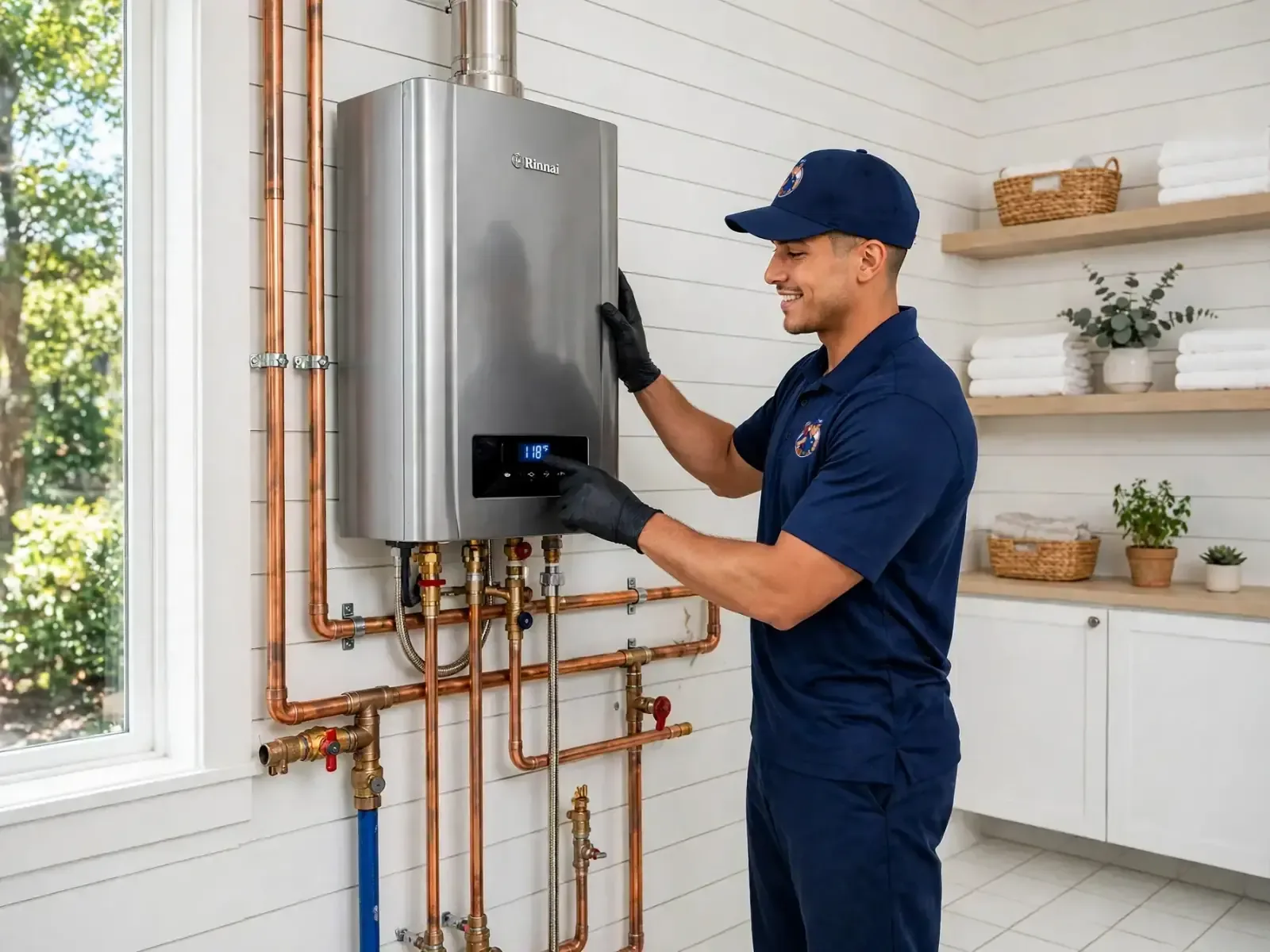
A tankless water heater heats water as it flows rather than keeping a tank hot around the clock. The practical benefits are hot water that does not run out, a unit small enough to free up a closet or a stretch of garage wall, no standby heat loss, and a service life that typically exceeds a tank heater's.
The caveat that matters here is water hardness. Supply in this region runs roughly 7 to 16 grains per gallon, with the harder end reaching the harbor communities, and scale is the main thing that shortens tankless life. Descaling is a maintenance requirement in this water, not an optional extra, and any guide that skips that is selling rather than advising.
What's In This Guide
How Tankless Differs
A tank heater keeps 40 or 50 gallons hot continuously, reheating whenever the stored water cools - whether anyone is using it or not. A tankless unit fires only when a hot tap opens, heating water through a heat exchanger on demand, and shuts off when the tap closes.
That single difference produces most of the advantages and most of the trade-offs. There is no stored volume to run out, and no stored volume losing heat. There is also no reservoir to buffer demand, so the unit has to be sized to the flow you actually want.
The Real Benefits
Hot Water That Does Not Run Out
The most noticeable difference day to day. Back-to-back showers, or a shower while the dishwasher runs, do not exhaust a reserve because there is no reserve to exhaust.
The limit is flow rate rather than volume: the unit can supply hot water indefinitely, up to the number of gallons per minute it is rated for.
Best fit for households where the current tank runs out at predictable times.
No Standby Heat Loss
A tank spends most of its life reheating water nobody has asked for. A tankless unit consumes nothing between draws.
How much that saves depends on your usage pattern and fuel cost, so it is worth being sceptical of any specific payback figure quoted without knowing your household.
The saving is real; the size of it varies too much between households to quote.
Space
A wall-mounted unit is a fraction of the footprint of a 50-gallon tank. In properties of the local build era, where the heater often sits in a garage corner or a hall closet, that space is worth something.
Often the deciding factor in smaller homes rather than the energy saving.
Longer Service Life
Tankless units generally outlast tank heaters, and their components are more often serviceable rather than requiring whole-unit replacement.
That advantage is conditional on maintenance. In hard water, a neglected unit will not reach its potential life.
Real, but it depends on descaling actually being done.
No Tank to Fail
A tank heater's worst failure is the tank itself splitting and releasing its contents. There is no stored volume in a tankless unit, so that particular failure mode does not exist.
Worth weighing if the heater sits somewhere a tank failure would do real damage.
The Local Catch: Hard Water
Tankless units heat water rapidly through a narrow heat exchanger. Hard water drops mineral out of solution when heated, and in a tankless unit that scale forms in the exchanger passages, which are far less tolerant of deposit than the open volume of a tank.
Scale reduces efficiency, restricts flow, causes temperature to fluctuate, and eventually triggers fault codes. Left long enough it damages the exchanger, which is the expensive component.
The Other Trade-offs
- Higher upfront cost than a like-for-like tank replacement.
- The cold water sandwich. Draw hot, stop briefly, draw again, and a slug of cooled water can arrive before the unit refires. Noticeable in some installations, minor in others.
- Flow rate is the ceiling. An undersized unit cannot supply two simultaneous demands, however long it runs.
- Gas supply and venting may need upgrading. Tankless units draw more gas when firing than a tank does, and the venting requirements differ.
- No hot water in a power cut, since the controls and ignition need electricity - though a gas tank with electronic ignition has the same limitation.
Sizing Matters More Than With a Tank
With a tank, capacity forgives a lot - a large reservoir covers a burst of simultaneous demand. With tankless there is no reservoir, so the unit must deliver the combined flow of everything running at once, raised from incoming temperature to the temperature you want.
Incoming water is comparatively mild in this climate, which helps: the unit has less temperature rise to achieve than it would in a cold region, so a given model delivers more usable flow here than the same model would elsewhere. Sizing should still be worked from your actual fixture count rather than assumed.
Weighing Tankless Against a Straight Tank Replacement?
The right answer depends on your fixture count, gas supply and how long you plan to hold the property. We handle tankless water heater installation and water heater installation across the harbor area, and we are licensed, bonded and insured.
Call (424) 402-3428What It Costs Here
| Work | Typical LA range |
|---|---|
| Tankless supplied and installed | $1,616 - $3,829 (around $2,668 typical) |
| Tank heater supplied and installed | $1,140 - $2,410 (around $1,740 typical) |
| Code-compliant 50-gallon gas tank installation | $2,200 - $3,500 |
| Venting work where required | $200 - $600 |
| Permit (tankless / tank) | reported around $175 / $125 |
Two local requirements affect both routes. A permit from Building and Safety is required for the work. And this air district enforces SCAQMD Rule 1121, which limits nitrogen oxide emissions from residential gas water heaters under 75,000 Btu per hour, so the unit has to be a compliant low-NOx model - a heater bought from outside the region may not be. Confirm current permit fees with LADBS, as fee schedules change.
Who It Suits
| Situation | Leaning |
|---|---|
| Tank runs out during normal use | Tankless |
| Space is genuinely constrained | Tankless |
| Planning to hold the property long term | Tankless |
| Straight like-for-like replacement on a budget | Tank |
| Unwilling to commit to annual descaling | Tank |
| Gas supply would need significant upgrading | Tank, usually |
| Heavy simultaneous demand across many fixtures | Depends on correct sizing |
Frequently Asked Questions
They do not run out by volume, because nothing is stored. The limit is flow rate: a unit can supply hot water indefinitely up to its rated gallons per minute. Exceed that by running several fixtures at once and the temperature will drop, which is why correct sizing matters more than with a tank.
Plan on roughly annually. Supply here runs about 7 to 16 grains per gallon, and scale forms in the narrow heat exchanger passages where it restricts flow and eventually damages the exchanger. Isolation valves fitted at installation make the service straightforward, so ask for them.
It depends on your usage and how long you will hold the property. The energy saving is real but its size varies too much between households to quote a payback period honestly. The clearer wins are unlimited hot water, the space saved, and the longer service life - provided the descaling gets done.
When you draw hot water, stop briefly and draw again, a short slug of cooled water sitting in the pipe can arrive before the unit refires. It is more noticeable in some installations than others and is generally a minor annoyance rather than a fault.
Possibly. Tankless units draw more gas while firing than a tank heater does, so the existing supply may need upgrading, and venting requirements differ from a conventional tank. This is a common reason a tankless quote comes in above the headline unit price, and it should be established before the work rather than discovered during it.
Yes. Water heater work in the City of Los Angeles requires a permit from Building and Safety, and the tankless permit fee is reported to be higher than the tank equivalent. Confirm current fees with LADBS before budgeting, as fee schedules change.
No. The controls and ignition need electricity. A gas tank heater with electronic ignition has the same limitation, so this is only a difference against older standing-pilot tank units.