
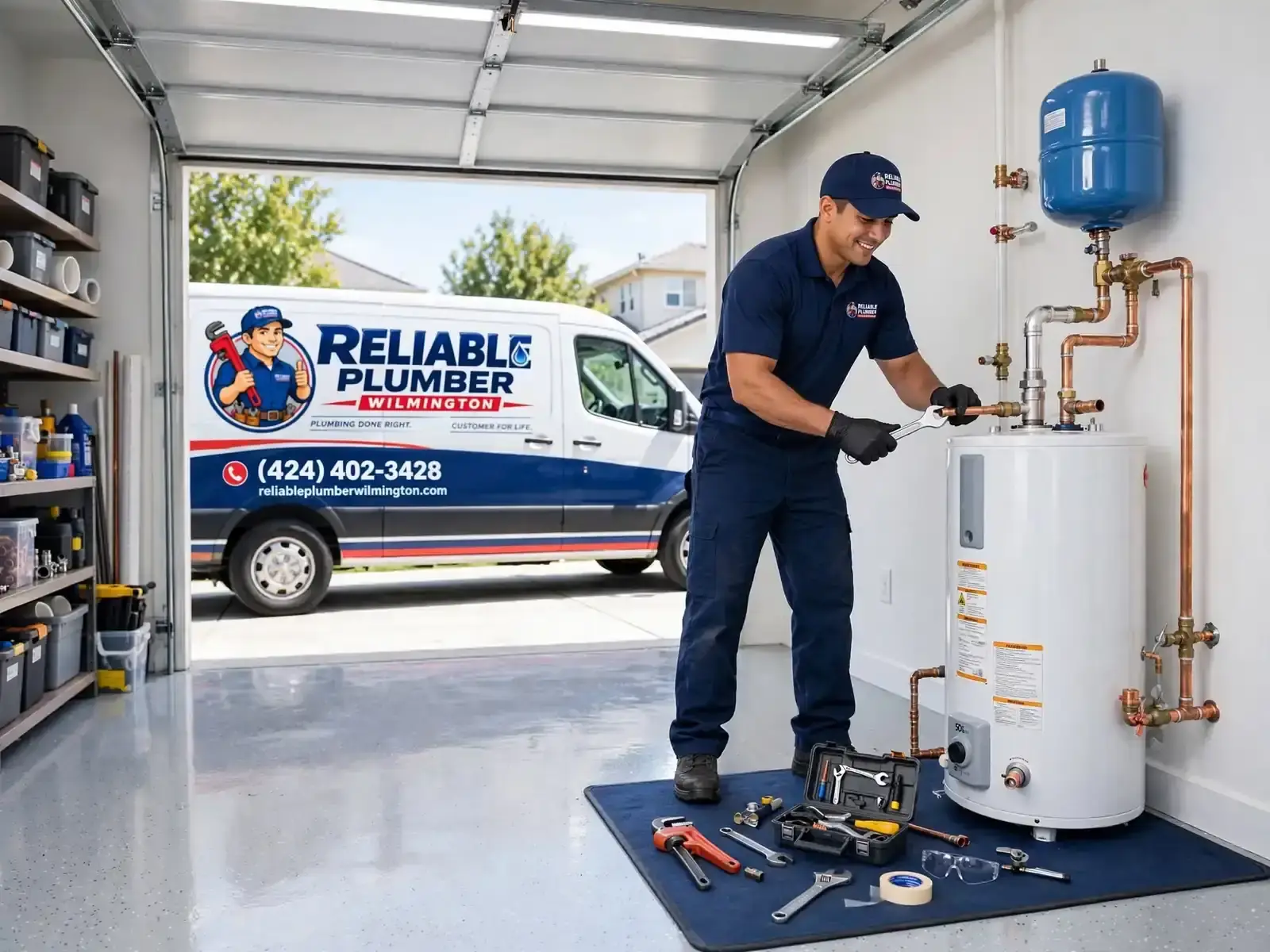
California requires every water heater to be braced against earthquake movement with two straps - one in the upper third of the tank and one in the lower third - with the lower strap sitting at least four inches above the controls. The requirement comes from Health and Safety Code section 19211, and the installation detail is set out in the California Plumbing Code at section 507.2.
It is a small piece of work with a large consequence. A full tank weighs several hundred pounds, and a heater that walks off its base in a quake tears the gas line and the water connections with it. That is why it is written into statute rather than left to good practice, and why it is the first thing an inspector looks at.
What's In This Guide
The Short Answer
- Two straps minimum on a standard residential tank.
- Upper strap in the top third of the tank.
- Lower strap in the bottom third, and at least 4 inches above the controls.
- Straps must be anchored into structure - studs or masonry - not into drywall alone.
- The requirement applies to existing heaters, not only new installations.
What the Law Actually Says
Health and Safety Code section 19211 is the statute. It requires water heaters to be braced, anchored or strapped to resist falling or horizontal displacement from earthquake motion. It puts the responsibility on the property owner, and it applies to residential water heaters generally rather than only to new work.
The California Plumbing Code at section 507.2 supplies the how: the two-strap arrangement, the positions, and the requirement that the anchoring resist horizontal movement. Between them, the statute says it must be braced and the code says what braced means.
Where the Straps Go
Upper Strap - Top Third of the Tank
This is the strap doing most of the work. A tall cylinder full of water wants to rotate about its base in a quake, and restraining the upper body is what stops that. Placed too low, it does very little.
Check: the upper strap should sit clearly in the top third, not around the middle of the tank.
Lower Strap - Bottom Third, 4 Inches Clear of the Controls
The lower strap stops the base sliding. The four-inch clearance above the controls exists so the strap cannot foul the thermostat, the gas valve or the burner access on a gas unit.
This clearance is a specific, measurable dimension, and it is one of the details that gets missed on otherwise tidy-looking installations.
Check: measure from the top of the control housing up to the strap. Less than four inches is a fail.
Tanks Over 75 Gallons
Two straps is the residential baseline. Larger tanks need more restraint because there is more mass to hold:
| Tank size | Straps required |
|---|---|
| Standard residential (typically 30 to 50 gallon) | 2 |
| 75 gallon | 3 |
| 100 gallon | 4 |
If you have a larger tank serving a bigger household or a small commercial space, count the straps. Three and four-strap installations are common enough to be routine, but a 100-gallon tank sitting on two straps is not compliant.
The Two Most Common Inspection Failures
On water heater work in Los Angeles, two items account for most of the corrections issued.
Strapping
The most common failure by a clear margin. Usually it is one strap where there should be two, straps positioned too close together in the middle of the tank, insufficient clearance above the controls, or anchors that have not found structure.
All four of these are visible without tools. Look before the inspector does.
The Expansion Tank
Second most common. Where a system is closed - typically because there is a pressure reducing valve or a check valve on the supply - heated water has nowhere to expand into, and pressure climbs. A thermal expansion tank absorbs that.
It is easy to overlook on a straight swap of an old heater, because the old installation may predate the requirement or may have been done without one.
If your supply has a PRV, expect to need an expansion tank with any new heater.
Not Sure Your Heater Is Compliant?
Strapping, expansion tanks and venting are all part of a standard install. We handle water heater installation and water heater repair across the harbor area, and we are licensed, bonded and insured.
Call (424) 402-3428How to Check Your Own Tank
- Count the straps. Two is the minimum on a standard tank. One is a fail. Zero is common on older installations and is also a fail.
- Look at where they sit. One should be clearly in the upper third, one in the lower third. Two straps bunched around the middle do not meet the requirement.
- Measure above the controls. The lower strap needs at least four inches of clearance above the control housing.
- Push on the tank. Gently. There should be no meaningful movement. If the tank rocks, the anchoring is not doing its job whatever the straps look like.
- Check what the anchors went into. If you can see screws in bare drywall with no stud behind them, that needs redoing.
- Look for an expansion tank if there is a pressure reducing valve on your incoming supply.
Permits and What They Cost
Replacing a water heater in Wilmington means working under City of Los Angeles rules, so the job requires a permit from the Department of Building and Safety. Most residential water heater permits are reported to go through the Express route via the PermitLA system rather than needing a full plan check, with inspection typically following within a few days of the work.
| Permit | Reported fee |
|---|---|
| Tank water heater | around $125 |
| Tankless water heater | around $175 |
The Other Rule That Catches People Out
Southern California has an air quality rule that does not apply in most of the state, and it covers Wilmington along with the rest of the South Coast basin. SCAQMD Rule 1121 limits nitrogen oxide emissions from residential gas water heaters under 75,000 Btu per hour to 10 nanograms per joule. In practice this means the heater you buy has to be a low-NOx or ultra-low-NOx model.
It matters for two reasons. A unit bought online or brought in from out of the area may not comply. And low-NOx burners can have different venting requirements than the unit being replaced, which is why a straight swap sometimes turns into a venting job. Budget for that possibility on an older installation rather than being surprised by it.
For context on cost, venting work commonly runs $200 to $600 on top of the heater and installation, and a compliant 50-gallon gas tank installation in Los Angeles typically lands somewhere around $2,200 to $3,500 depending on the unit and what the existing installation needs brought up to standard.
Frequently Asked Questions
Two on a standard residential tank - one in the upper third and one in the lower third, with the lower strap at least four inches above the controls. Larger tanks need more: three straps on a 75-gallon tank and four on a 100-gallon tank.
Yes. Health and Safety Code section 19211 applies to existing residential water heaters, not only to new installations. An unstrapped heater that has been in place for years is out of compliance now, and it commonly comes up at point of sale.
Strapping alone is a small job and kits are widely sold. The parts worth being careful about are anchoring into actual structure rather than drywall, and keeping four inches of clearance above the controls. If the heater is being replaced rather than just braced, that work needs a permit and should be done by a licensed contractor.
If your supply has a pressure reducing valve or a check valve, the system is closed, so water heated in the tank has nowhere to expand and pressure rises. An expansion tank absorbs that. It is the second most common water heater inspection failure after strapping, and it is easy to miss on a like-for-like replacement of an older unit.
Yes, in the City of Los Angeles a permit from Building and Safety is required. Most residential water heater permits are reported to go through the Express route rather than a full plan check. Confirm the current fee and process with LADBS, as fee schedules change.
In this air district, SCAQMD Rule 1121 caps nitrogen oxide emissions from residential gas water heaters under 75,000 Btu per hour at 10 nanograms per joule, which means a low-NOx or ultra-low-NOx unit. A heater bought from outside the region may not comply, and low-NOx models can have different venting requirements than the unit being replaced.
Practically, an unstrapped tank can shift or topple in an earthquake and take the gas and water connections with it, which is the reason the requirement exists. Administratively, it is a code violation that will be flagged on any inspection and can hold up a sale or a permit sign-off on other work.