
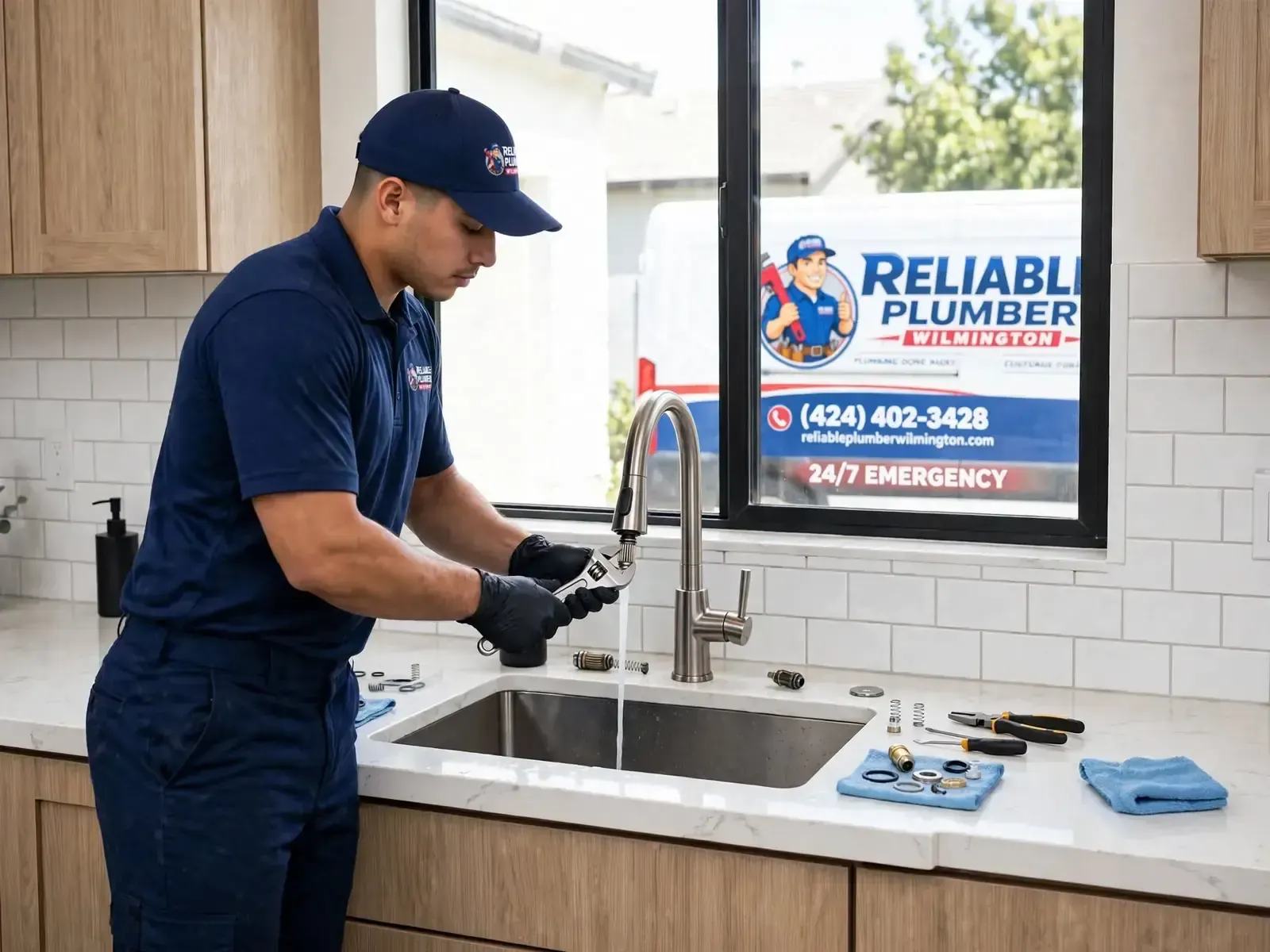
A dripping faucet is almost always a worn seal, and which seal depends on the valve type. Compression faucets fail at the rubber washer, ball faucets at the springs and seats, cartridge faucets at the cartridge itself, and ceramic disc faucets at the inlet seals or the disc cartridge. Identify the type before buying anything, because parts are not interchangeable between them.
It is worth doing promptly. According to EPA WaterSense, a faucet dripping once per second wastes more than 3,000 gallons a year, and a dripping tap is the single most common household plumbing repair.
What's In This Guide
Why a Drip Is Worth Fixing
- One drip per second is over 3,000 gallons a year down the drain.
- A hot-side drip wastes the energy used to heat that water as well as the water itself.
- Constant running wears the seat, so a cheap seal replacement becomes a bigger repair the longer it is left.
- Standing moisture around the base and beneath the sink causes damage that costs more than the tap did.
Identify Your Faucet Type First
This is the step that determines everything else. The quickest indicator is how the handles behave.
| What you have | Type |
|---|---|
| Two handles that tighten progressively and need effort to stop the drip | Compression |
| One handle over a domed cap, moving in any direction | Ball |
| One or two handles turning smoothly through a quarter to half turn | Cartridge |
| One handle over a wide cylindrical body, smooth and firm | Ceramic disc |
Before You Start
- Shut off the supply at the stop valves under the sink. If they will not turn or will not seal, stop and shut off at the main instead.
- Open the tap to drain the remaining pressure.
- Plug the drain with a cloth. Small parts and screws find plugholes reliably.
- Photograph each stage as you disassemble. Reassembly order matters and is easy to get wrong.
- Lay parts out in order on a towel rather than in a heap.
- Take the old part to the shop rather than guessing at a match. Sizes vary between models that look identical.
1. Compression Faucets
Oldest Design, Simplest Repair
Two handles, each screwing a stem down onto a rubber washer to close against a seat. Common in properties of the local build era and still widely found on laundry and outdoor taps.
A drip from the spout is nearly always the washer. Leaking around the handle is usually the packing or O-ring on the stem.
Replace the seat washer at the base of the stem, and the stem O-ring while it is apart.
If the drip persists with a new washer, the seat it presses against is likely scored. Seats can be dressed with a seat wrench and reamer, or replaced if they are the removable type. A scored seat chews through new washers quickly, so it is worth checking rather than repeatedly replacing the washer.
2. Ball Faucets
Most Parts, Most Fiddly
A single handle over a slotted metal ball. Water flow and temperature are set by how the ball aligns with two spring-loaded rubber seats.
Dripping from the spout means the springs and seats have worn. Leaking around the base of the spout means the body O-rings.
Buy the complete repair kit for your model rather than individual parts - it includes the ball, seats, springs and O-rings.
This is the type most worth photographing during disassembly. There are more small components than the other three, and the cam and packing have to go back in a specific orientation to seal.
3. Cartridge Faucets
Usually the Easiest Fix
One or two handles, each operating a removable cartridge. The handle turns smoothly through a limited arc with no progressive tightening.
The repair is normally to replace the whole cartridge rather than any individual seal, which makes this the most straightforward of the four.
Match the replacement cartridge to the make and model. Note the orientation before pulling the old one - fitting it rotated reverses hot and cold.
Cartridges can be stubborn after years of mineral deposit, and this region's supply runs roughly 7 to 16 grains per gallon, so scale is common. A cartridge puller is the right tool. Levering against the faucet body tends to crack it.
4. Ceramic Disc Faucets
Longest Lasting, Rarely the Discs
A single handle over a wide cylinder containing two ceramic discs that slide across each other. The discs themselves are extremely durable and seldom the cause of a leak.
Far more often the problem is the rubber inlet seals underneath, or mineral deposit interfering with the seal.
Lift out the cylinder, clean the inlet seals and their seats, and replace the seals. Replace the cylinder only if cleaning does not resolve it.
Leak Not Stopping After a Repair?
A drip that returns usually means a worn seat or a supply pressure problem rather than a bad part. We handle faucet repair and faucet installation across the harbor area, and we are licensed, bonded and insured.
Call (424) 402-3428When the Leak Is Not the Faucet
| What you see | Where the problem actually is |
|---|---|
| Water pooling under the sink, spout dry | The supply connections, the stop valves or the drain trap - check those before dismantling the tap. |
| Every tap in the house drips | Supply pressure, not four simultaneous failures. |
| A drip returns weeks after a good repair | Excessive pressure destroying new seals. |
| Water around the base of the spout when running | Body O-rings, not the valve seals. |
On the pressure point: the California Plumbing Code caps static supply pressure at 80 psi and requires a pressure reducing valve where incoming pressure exceeds that. The valve sits after the meter and the property owner maintains it. If new washers or cartridges are failing repeatedly, get a static pressure reading before replacing anything else.
Repair or Replace
Repair is usually the better call for a decent faucet with an available parts kit. Replacement makes more sense when the body is corroded, when parts are no longer available for the model, or when the fixture is being changed anyway.
| Work | Typical LA range |
|---|---|
| Kitchen faucet supplied and installed | $200 - $600 |
| Shower valve cartridge | $100 - $350 |
| Shower valve work | $170 - $625 (around $398 typical) |
| Plumber hourly rate | $95 - $200 |
| Service call / diagnostic visit | $75 - $150 |
If you are replacing rather than repairing, note that California sets maximum flow rates on new fixtures: lavatory faucets at 1.2 gallons per minute at 60 psi, and showerheads at 1.8 gallons per minute at 80 psi. Any current fixture sold for the state will comply, but it is worth knowing why a new tap may feel different from a very old one.
Frequently Asked Questions
Go by the handle. If it tightens progressively and you can squeeze the drip down by turning harder, it is compression. A single handle over a domed cap that moves in any direction is a ball faucet. Handles that turn smoothly through a short arc are cartridge. A single handle over a wide cylinder is ceramic disc.
EPA WaterSense puts a drip once per second at more than 3,000 gallons per year. On the hot side you are also paying to heat all of it, so the cost is more than the water alone.
The seat the washer closes against is probably scored, so the new washer cannot seal and will wear quickly. Seats can be dressed with a seat wrench and reamer or replaced if they are the removable type. The other possibility is excessive supply pressure destroying new seals.
Four simultaneous failures is unlikely; excessive supply pressure is the common explanation. The plumbing code caps static pressure at 80 psi and requires a pressure reducing valve above that, and the valve is the owner's to maintain. Take a static pressure reading at a hose bib before replacing parts.
Usually yes, particularly a cartridge type. The parts that catch people out are shutting off cleanly at the stop valves, matching the replacement part to the exact model, and reassembling in the right orientation. Take the old part with you rather than guessing, and photograph each stage as you go.
Mineral deposit, usually. Supply in this region is moderately hard, so cartridges bind after a few years. Use a cartridge puller made for the job. Levering against the faucet body risks cracking it, which turns a small repair into a replacement.
Repair if the body is sound and a parts kit is available - it is cheaper and faster. Replace if the body is corroded, if parts are no longer made for the model, or if you were planning to change the fixture anyway. Kitchen faucets supplied and installed commonly run $200 to $600 in this area.