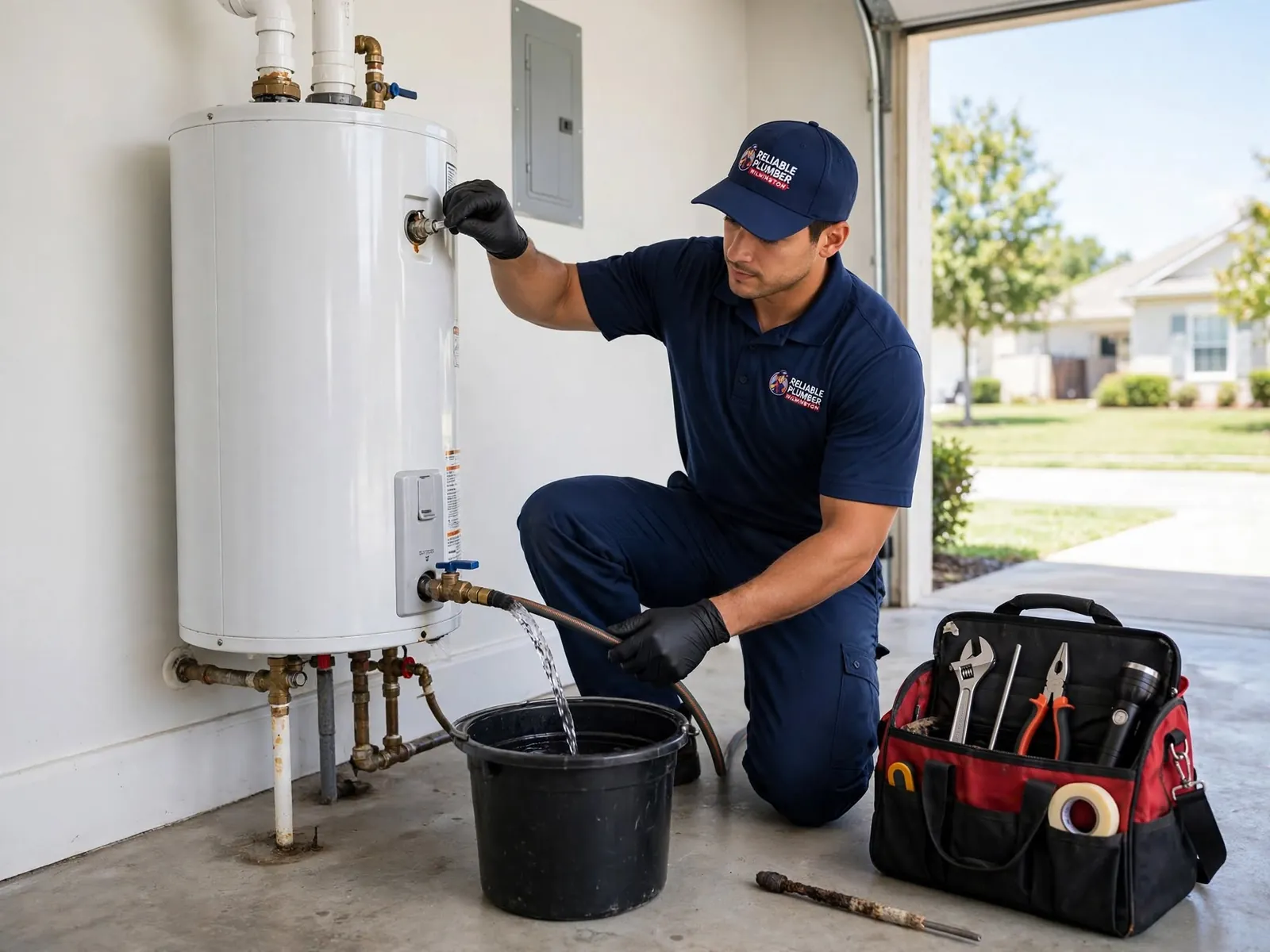
Water Heater Maintenance Wilmington CA

Three tasks decide where in the 8-to-12-year range your tank lands: flushing sediment, replacing the anode rod before it is consumed, and testing the T&P valve. On water this hard, flushing matters most.

Reliable Plumber Wilmington review platform
Water Heater Maintenance in Wilmington, CA

The Anode Rod Is the Part Nobody Checks

A water heater tank is steel with a glass lining. Steel in constant contact with hot water corrodes, and the reason your tank has not already is a component most owners have never heard of.

The anode rod is a magnesium or aluminium rod suspended inside the tank that corrodes preferentially - sacrificing itself so the steel does not. It is doing that from the day the heater is installed, and it is finite. Once consumed, corrosion transfers to the tank.

Replacing a rod is inexpensive. Replacing a tank because nobody checked one is not, and that sequence is behind a large share of water heaters that fail at six or seven years instead of twelve.

Wilmington 90744 note: manufacturer maintenance advice is written for national averages. Harbor-area water sits at the harder end of the 7 to 16 grains per gallon Los Angeles range, which means sediment builds faster here than that advice assumes. Once a year is a starting point on this water, not a ceiling - and a tank that has never been flushed will land at the short end of its expected life.

What to Do, and How Often

Four tasks. The intervals below are the published guidance, adjusted where local water hardness justifies it.

TaskIntervalWhy it matters
Flush the tankAt least annually; more often on hard waterRemoves sediment insulating the burner and stealing capacity
Inspect the anode rodEvery 2-3 yearsEstablishes how much sacrificial material is left
Replace the anode rodEvery 3-5 yearsSooner on softened water; the range runs 6 months to 6 years
Test the T&P valveAt least annuallyConfirms the safety device has not seized with scale
Check the temperatureAnnually120°F limits scale formation and scald risk

A useful mnemonic for the T&P test: do it when the clocks change. Some manufacturers recommend inspecting it every six months, which fits that habit neatly.

The T&P Valve Is Not Optional Equipment

It is the single component standing between a pressurised tank and a serious incident.

Relieves Pressure
Vents if temperature or pressure exceeds safe limits
Test Annually
Lift the handle, confirm it discharges and reseats
Never Cap It
A discharging valve is reporting a problem, not causing one
Check the Expansion Tank
Repeated discharge often means this is missing or failed

The temperature and pressure relief valve opens if either exceeds safe limits, venting to a drain rather than allowing the tank to over-pressurise. Testing it is simple: lift the handle briefly, confirm water discharges, and confirm it reseats cleanly when released.

It seizes with scale like everything else in hard water. A valve that has never been tested is a valve nobody can rely on, which defeats the purpose of having one.

If yours discharges repeatedly, that is information rather than a fault in the valve. It commonly means the system is closed - a pressure-reducing valve or backflow preventer is fitted - and there is no thermal expansion tank to absorb the expansion. The correct response is fitting one, not replacing the valve repeatedly and certainly not capping it. See water heater installation for the expansion tank requirement.

Need Water Heater Maintenance in Wilmington?

Cause diagnosed before anything is quoted · price agreed before work starts · 24/7 dispatch

Water Heater Maintenance Price Ranges in Los Angeles County

Maintenance sits at the low end of plumbing work, and the comparison row is the whole argument for doing it.

WorkRangeWhat moves it
Standard hourly$95 - $200/hrPlus a $75 - $150 service call fee
Typical simple repairfrom about $125Los Angeles average for straightforward component work
For comparison - replacement$1,140 - $2,410What unmaintained tanks eventually cost, years early

Maintenance is the cheapest line on this list and it is the one that moves the others further away.

Five Habits That Add Years

Two of these you can do yourself. The other three are worth a scheduled visit.

01

Flush on a hard-water schedule

Once a year is the general guidance, and harder water justifies more often. Sediment on the tank floor insulates the burner, forces it to run hotter and longer, and occupies volume that used to hold water - so a 40-gallon tank starts behaving like a 30.

02

Get the anode rod inspected before it is gone

Inspect every two to three years and replace every three to five, sooner on softened water. The realistic range runs from six months to six years depending on water composition. Once it is consumed, the tank starts corroding instead - and that is the failure you cannot repair.

03

Test the T&P valve when the clocks change

Lift the handle, confirm it discharges and reseats. It takes seconds and it verifies the one component preventing a pressurised tank failing dangerously. Some manufacturers suggest every six months, which the daylight-saving habit covers neatly.

04

Set the thermostat to 120°F

Higher settings accelerate scale formation on hard water and raise scald risk without giving you meaningfully more usable hot water. On this water, temperature control is directly a tank-life measure.

05

Treat new noises as early warnings

Popping and rumbling mean sediment has built up enough that water is flashing to steam beneath it. That is the audible stage of a process that has been running silently for a while, and it is the point at which flushing still helps.

Water Heater Maintenance in Wilmington, CA - The Complete Guide

Water heaters are the most predictable appliance failure in a house. They have a known service life, a known failure mode, and a maintenance task that measurably extends it. Almost nobody performs it.

The Failure Mechanism, Step by Step

Cold water enters at the bottom of the tank and is heated from below. Calcium and magnesium come out of solution as the water heats and settle on the tank floor - exactly where the heat is applied.

That sediment layer insulates. The burner runs longer and hotter to drive heat through it, so the steel above it operates above its design temperature for years. The glass lining eventually crazes and the steel beneath begins corroding.

Meanwhile the anode rod has been corroding sacrificially the whole time. Once it is consumed, there is nothing left protecting the steel, and corrosion accelerates. The tank eventually perforates and leaks from the body - which is the one water heater fault with no repair.

Every step in that chain is slowed by the same two tasks: removing the sediment, and replacing the rod before it runs out.

Flushing - What It Does and How Often

Flushing drains the tank and carries accumulated sediment out with the water. It restores effective capacity, removes the insulating layer above the burner, and quiets the popping and rumbling that sediment causes.

General guidance is once a year for most households, with hard water justifying more frequent flushing. Harbor-area supply sits toward the harder end of the Los Angeles range, which puts most properties here in the "more often" category rather than the default.

One caution worth knowing: a tank that has gone many years without flushing can be a different proposition. Heavily compacted sediment does not always drain cleanly, and disturbing it in a tank that is already corroded occasionally reveals a leak that was being held shut. That is not a reason to avoid flushing - it is a reason to start early rather than at year ten.

The Anode Rod in Detail

Anode rods are magnesium or aluminium, chosen because they corrode more readily than steel. Electrochemically, the rod becomes the sacrificial element and the tank is protected as long as material remains.

Inspection every two to three years and replacement every three to five is the standard guidance. The real-world range runs from six months to six years depending on water composition, and softened water consumes rods notably faster.

The economics are stark. A rod is a modest part fitted in a short visit. A tank is $1,140 to $2,410 installed in Los Angeles, plus removal of the old one. Skipping a $150 job to face a $1,700 one several years early is the single worst trade in residential plumbing, and it is extremely common.

What Maintenance Cannot Fix

If the tank body is already leaking, maintenance is not the answer - that is replacement, because corroded steel cannot be repaired.

If a component has failed - thermostat, element, thermocouple, gas control valve - that is repair, and maintenance afterwards keeps the next one further away.

And if the unit is over twelve years old, maintenance improves the odds without changing the fundamentals. At that age the sensible plan is a scheduled replacement rather than waiting for the tank to choose the timing.

References

Water Heater Maintenance Questions

Answers specific to water heater maintenance in Wilmington 90744.

At least once a year for most households, and more often on hard water. Harbor-area supply sits at the harder end of the 7 to 16 grains per gallon Los Angeles range, which puts most properties here above the default interval.

A magnesium or aluminium rod inside the tank that corrodes preferentially so the steel does not. Once it is consumed, the tank begins corroding instead - and a corroded tank is the one water heater fault with no repair.

Inspect every two to three years and replace every three to five. The real range runs from six months to six years depending on water composition, and softened water consumes them faster.

Lift the handle briefly, confirm water discharges, and confirm it reseats cleanly when released. At least annually - a useful habit is doing it when the clocks change, since some manufacturers suggest every six months.

Often not. Repeated discharge usually means the system is closed by a pressure-reducing valve or backflow preventer with no thermal expansion tank to absorb expansion. The fix is fitting one - never capping the valve.

120°F. Higher settings accelerate scale formation on hard water and raise scald risk without giving you meaningfully more usable hot water.

Book Water Heater Maintenance in Wilmington

Licensed, bonded and insured · diagnosis before price · 30 cities across Los Angeles County