Sewer Line Cleaning in Wilmington, CA - The Complete Guide
A blocked main lateral is the point at which a drain problem stops being a nuisance and starts being a house problem. Recognising it early is mostly a matter of counting.
Where the Lateral Runs, and Who Owns It
The lateral is the private pipe connecting your building to the public sewer in the street. It has two conventional sections: the upper lateral from the building to the property line, and the lower lateral from the property line to the main.
In the City of Los Angeles the property owner is responsible for maintaining and repairing all of it, including the lower section under the roadway. The reasoning is that a lateral serves a single lot rather than the community, so it cannot be maintained at the expense of ratepayers generally.
This matters for cleaning as much as for repair, because a blockage in the lower lateral is still your call to make and your bill to pay - even though it sits under public road.
Getting Into the Line
Access is normally through a cleanout: a capped fitting installed specifically so the lateral can be reached without dismantling anything. Where a property has an accessible cleanout, clearing the main line is a considerably simpler job.
Where it does not - and older properties frequently do not - access has to be found another way, typically by pulling a toilet or working through a roof vent. That takes longer and costs more, which is why installing a cleanout is often worth doing at the same time as any other lateral work.
Clearing It, Then Explaining It
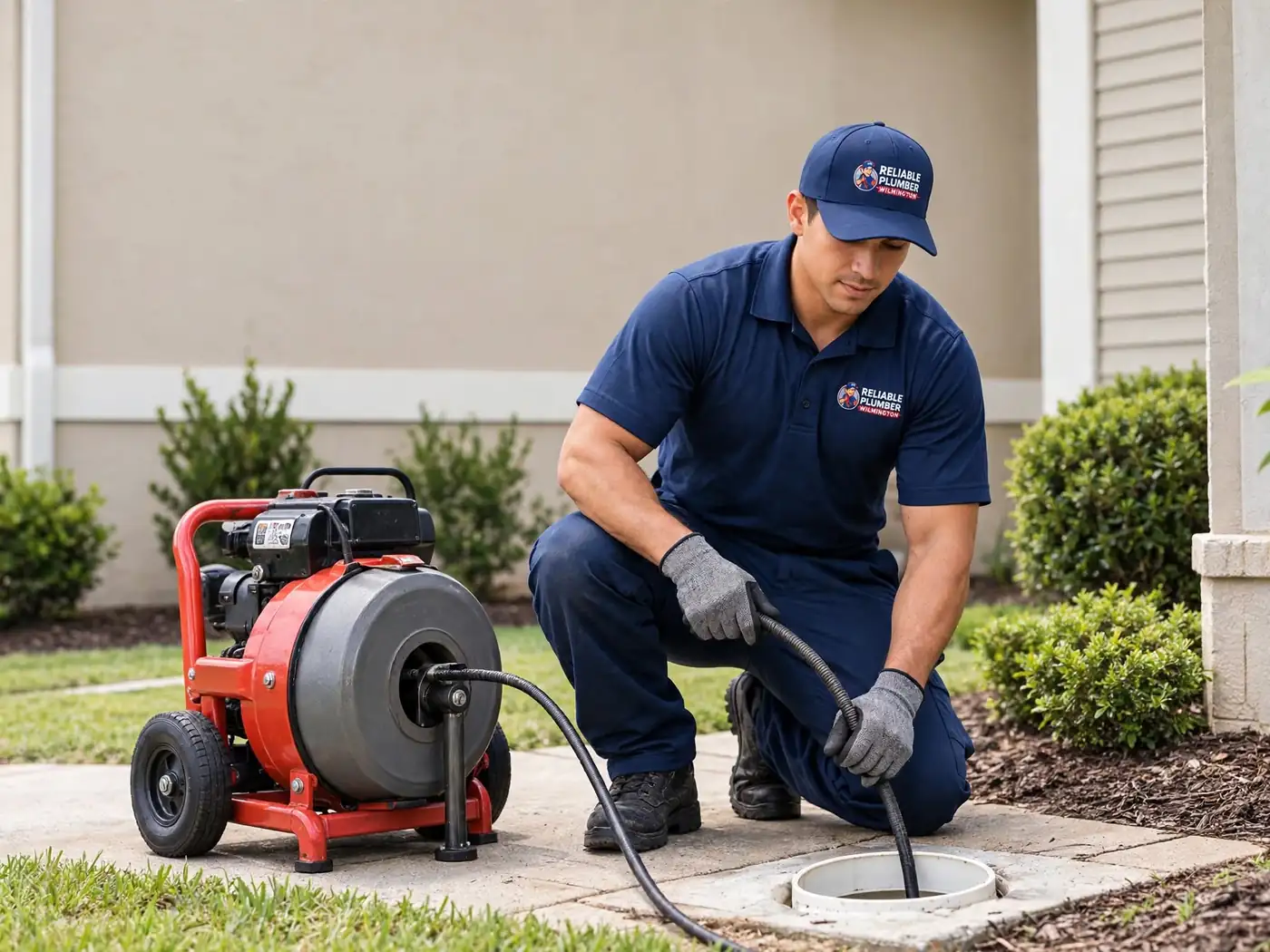
A powered auger clears most main-line blockages. That restores the house to normal service, which is the urgent part of the job.
It does not explain why a lateral that has worked for decades stopped working now, and on 1940s to 1960s cast iron there is usually a reason. Scale narrows the bore progressively; cracked or offset joints catch material and admit roots. Either produces a blockage that will recur, because the condition causing it is still there.
A camera inspection after clearing separates the two outcomes. Deposit means jetting. A structural defect means the conversation moves to sewer line repair. Skipping this step is how the same backup happens twice.
Roots
Root intrusion is among the most common causes of sewer lateral blockage in Los Angeles, where mature ficus and sycamore are widespread in older residential neighbourhoods.
The causal order is worth being precise about, because it changes the correct response. Roots do not break sound pipe. They enter joints that have already cracked or pulled apart, then expand and trap debris. Cutting them out restores flow; it does not close the joint they came through, so they come back.
Responsibility follows the pipe rather than the tree. Roots from a street tree entering your lateral are still your lateral, which is another consequence of the ownership rule above.
References