Pipe Bursting in Wilmington, CA - The Complete Guide
Pipe bursting is the method people reach for when a lateral is genuinely finished. Understanding what it does differently from lining explains why.
Why Upsizing Is the Real Differentiator
Lining and bursting are often presented as interchangeable trenchless options. On diameter they are opposites.
A CIPP system decreases the inside diameter of the existing pipe, because the liner occupies space within the original bore. That is normally acceptable on a residential lateral, but it is a reduction.
Pipe bursting is not constrained by the original internal diameter at all. You can maintain the same nominal size, and in many cases upsize by one or more pipe sizes depending on soil conditions and adjacent utilities. Where a lateral has always been marginal - an older property that has since been extended, or one where drainage has never quite kept up - that is a genuine improvement rather than a replacement in kind.
The Case for Bursting Over Lining
The host pipe has failed structurally. Lining needs something sound enough to form against; bursting does not care what condition the old pipe is in because it is destroying it.
The line has a belly. Lining conforms to existing geometry, so it cannot restore fall. Bursting installs new pipe and can correct grade.
You want more capacity than you had. Only bursting offers that.
The pipe material is one that lining suits poorly, or previous partial repairs have left the bore inconsistent along its length.
The Case Against
It costs slightly more per foot than lining in the Los Angeles market - $145 to $195 against $135 to $185.
It is more sensitive to what surrounds the pipe. Concrete encasement, dense backfill, close utilities and sharp bends all obstruct it in ways that do not affect lining.
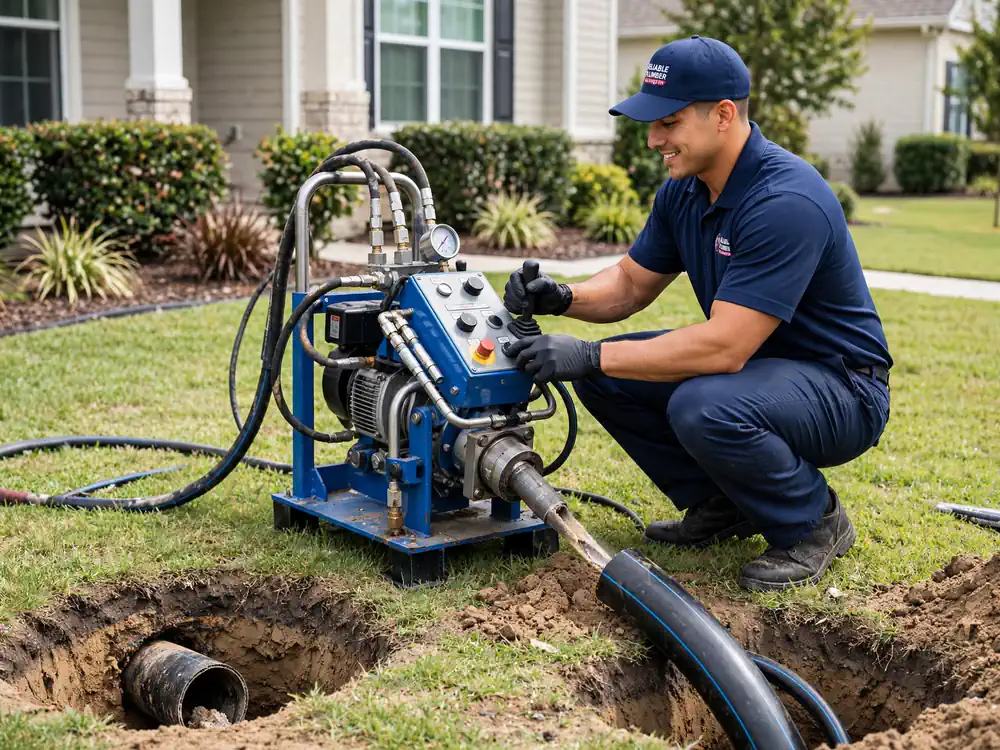
It requires larger access pits than lining, since new pipe has to be fed in along the run.
Where the existing lateral is structurally sound and simply cracked or root-infiltrated at joints, lining does the job with less ground disturbance. Bursting a line that could have been lined is over-solving the problem.
What Happens on the Day
The line is cameraed and located, and adjacent utilities are marked. Two access pits are excavated, typically at the building end and near the connection to the main.
The bursting head is winched through the run, fracturing the old pipe outward into the surrounding soil while the new pipe follows immediately behind it in the same pull. On a standard residential lateral this stage is measured in hours rather than days.
Connections are remade at both ends, the line is cameraed again to confirm grade and flow, and the pits are backfilled. Permits apply: an S-Permit is required to connect to the City of Los Angeles sewer, with a supplemental S-Permit where the original defect was major - see sewer line repair for the permitting detail.
References